



Bold contributions to mathematics
Blaise Pascal viewed geometry as the most beautiful profession. Seduced from a very young age by the classics of mathematical literature that his father entrusted to him, he devoured them until producing new results himself. He also developed new ways of reasoning by proving several properties by induction, a novel fact at the time. Arithmetic, conics, genesis of probability and combinatorics: all the domains attracted the prodigy from Clermont.
All articles in this folder

Pascal and geometry: the mystic hexagram | Tangente
Blaise Pascal's earliest work in geometry has passed into legend. He was only 16 when he published his Essay pour les coniques (Essay on Conics) in 1640.
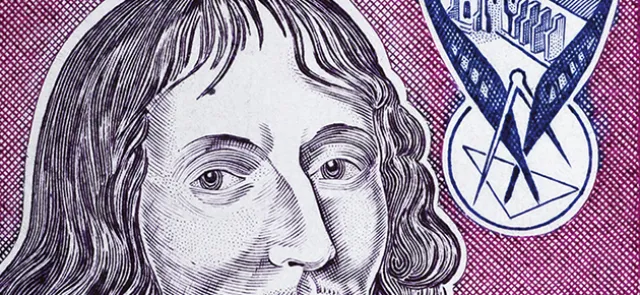
A master of mathematical induction
Mathematical induction is a major tool in mathematical proofs. On at least three occasions, Pascal explicitly uses reasoning that is "almost" mathematical induction, making him one of the method's inventors.

Pierre de Fermat, Pascal's famous contemporary | Tangente
Who was Pierre de Fermat? Pascal regarded him as the greatest mathematician of his time. He was a very modest man, probably aware of his extraordinary mathematical abilities, who readily shared his often original ideas. We know that he was a man of great learning, capable of translating works from Latin and Greek and writing sophisticated poetry, even… in Spanish.
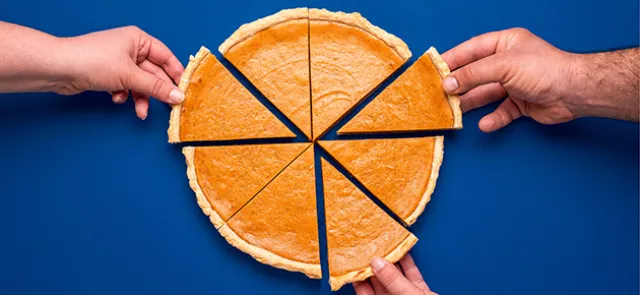
The art of fair division
Blaise Pascal had a gift for illuminating all manner of situations through sound, precise analysis, pinpointing the difficulties and explaining himself with unsurpassable clarity. One of the most famous questions in probability—the problem of points—was a case in point.

A neatly wrapped gift—Divisibility | Tangente
Is the integer 19,061,623 divisible by 37? It is hard to answer "quickly." Yet there is a way to devise simple, effective divisibility tests in no time, without having to perform the division by hand. Blaise Pascal has an arithmetic gift for you!
Properties of the arithmetic triangle
Although Blaise Pascal did not invent the triangle that bears his name, the name pays tribute to his study of it in a treatise that has remained famous in the history of mathematics. Let's delve into this extraordinary text!