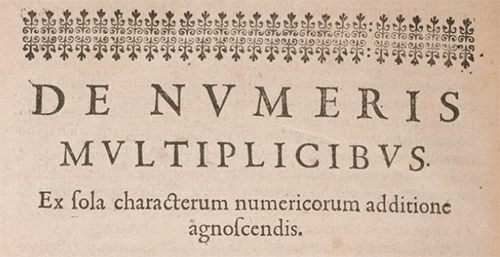
Even the youngest readers know how to spot a multiple of 9 without getting bogged down in long division (and without a calculator): simply add up the digits of the integer, repeating the process several times if necessary. The digits of any multiple of 9 add up to a number that is itself a multiple of 9. But what if we are considering some other possible divisor? Is there a method as simple as adding the digits? Blaise Pascal examined the question and turned his findings into a short Latin treatise of around ten pages, De numeris multipicibus, containing a single proposition illustrated by numerous examples. The text was mentioned in 1654 but was not published until 1665, after Pascal's death, following the Traité du triangle arithmétique, from which it is entirely independent.
The master's ribbon
------------------
Let's follow the little recipe devised by the mathematician from Clermont. Before we can reap the rewards of this arithmetic gem, we must make the ribbon that wraps the gift. So what exactly is "Pascal's ribbon"?
Let A denote the divisor we are interested in. We begin with a simple two-row table: