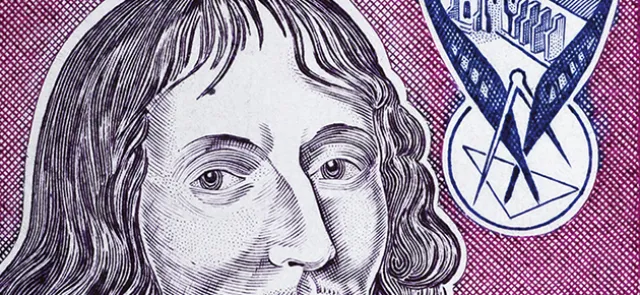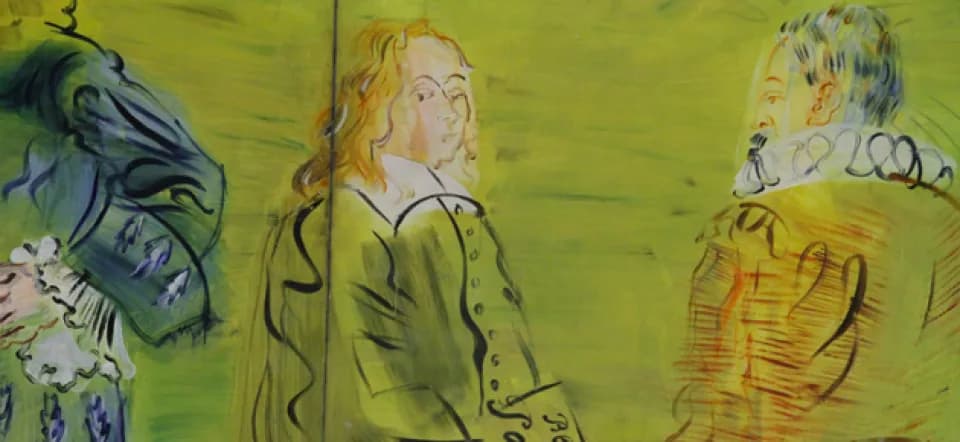
Blaise Pascal (1623–1662), as depicted by Raoul Dufy in 1937 in La Fée Électricité (The Electricity Fairy), a 600 m² fresco on display at the Musée d’Art moderne de la Ville de Paris.
Pascal's triangle is well known to mathematics enthusiasts. It has fascinated many scholars over the centuries (see our feature " Pascal's triangle ", Tangente 176, 2017).
This is particularly true in China, where it is named after the mathematician Hui Yang (1238–1298) and was used by Shijie Zhu (1270–1330) in his Miroir de Jade des Quatre origines in 1303. The famous triangle also appears in the works of illustrious Arab and Persian scholars such as the poet Omar Khayyâm (1048–1131).
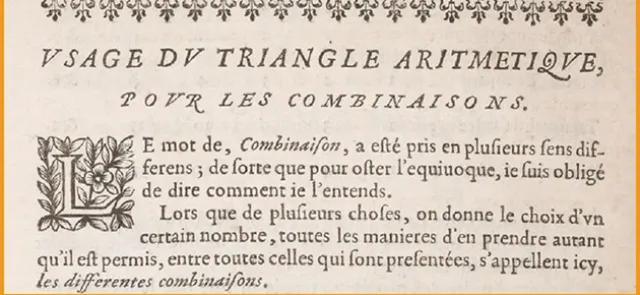
Yet it is no accident that the triangle came to bear Blaise Pascal's name in Western literature. In 1654, the many-sided genius, then aged 31, wrote his Traité du triangle arithmétique, which he supplemented with "quelques autres petits traitez sur la mesme matiere" ("several other short treatises on the same subject"). One of Pascal's aims was to solve the famous problem of points, which gave rise to probability theory (see *The emergence of probability theory in Tangente* 193, 2020).
Let us focus, however, on how the triangle is constructed and on some of the properties that follow from it.