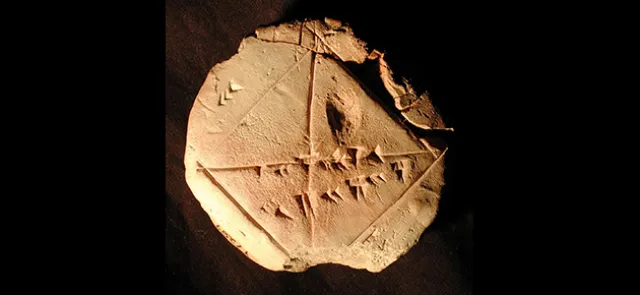
Extracting roots is surely no fun when performed by a dentist, but in mathematics it is far easier than it might seem. Suppose, for example, that we want to calculate the square root of 31 by hand. We can proceed by trial and error: since 31 lies between 52 = 25 and 62 = 36, it follows that lies between 5 and 6. We can then continue in the same way to determine the first decimal place (31 lies between 5.52 and 62, then between 5.52 and 5.752, then…), the second, and so on. The calculations are numerous and increasingly tedious, but a decimal place can be gained in just a few steps.
Another method produces a better result with far fewer calculations.
Heron has an eye for area
--------------------------
Little is known about Heron of Alexandria, beyond the fact that he lived in the 1st century CE and perhaps into the early 2nd century. A native of Alexandria, he is thought to have lived mainly in Roman Egypt (see our feature "Heron's formula" in Tangente 180, 2018). In his day, he seems to have been known for designing machines intended to inspire wonder, using clockwork mechanisms or devices that automatically opened temple doors. These ingenious constructions, which would not be perfected until many centuries after his death, relied on compressed air or water and are described in his Pneumatics. His writings were translated into Latin and then Arabic, and received various commentaries and additions before being rediscovered in the late 19th century, making it difficult to trace the precise authorship of some elements.
Yet, like any self-respecting Greek geometer, Heron of Alexandria also wrote treatises on physics and mathematics, including the Metrica. There he states and proves his famous result on the area of triangles, now summed up in a simple formula. The area of a triangle with sides a, b, and c is given by where p is the triangle's semiperimeter, that is,