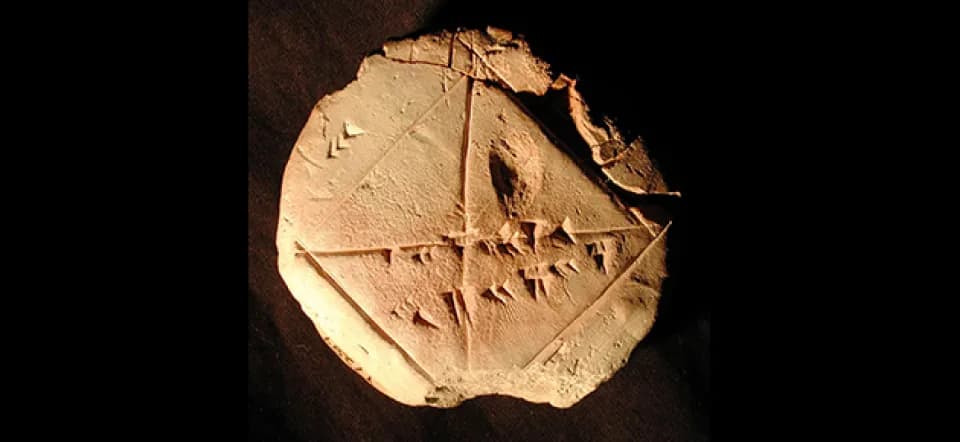
The small clay tablet YBC7289 (YBC stands for Yale Babylonian Collection) fits in the palm of your hand. It dates from between 1900 and 1600 BCE. Its surface bears a square with both diagonals and several cuneiform signs, whose transcription indicates that if the side of the square is 30 units long, its diagonal is 42.4263889 units long. This gives an approximation to of 1.41421296 (the incorrect decimal places are shown in blue). It therefore seems that the Babylonians knew how to calculate certain square roots from a very early date.
-
Early geometric constructions
------------------------------------
How did the Babylonians proceed? They probably performed two iterations of Heron's method (described in detail below). Unfortunately, examples of Greek square-root calculations are rare in the surviving literature of antiquity. One of the few known examples comes to us from Theon of Alexandria (also known as Theon the Mathematician, Hypatia's father), who lived in the 4th century CE. It appears in his commentary, written around 372, on Ptolemy's Almageste (the "mathematical syntax"). Ptolemy gives 67°4'55'' as an approximation of , without any explanation. Theon describes the calculation through a geometric construction (see box).
Theon then summarizes his calculation by describing a general algorithm. It is based on Proposition 4 of Book II of Euclid's Elements, which in modern notation reads *(x+y)2=x2+2xy+y2*—a familiar algebraic identity to high-school students!