



Iterative processes and induction
Clearly appearing in Pascal's writings on arithmetic and combinatorial questions (including Pascal's triangle), reasoning by induction finds a natural place in the study of sequences, making it possible to formalize, generalize and then improve approximate methods for solving equations known for centuries. Henri Poincaré will say that it is "mathematical reasoning par excellence". Induction allows for some of the most memorable constructions, from the Fibonacci sequence to Heron's algorithm (to approximate the square root of a positive number). While the iteration of a computational process addresses practical problems since Antiquity (often to improve the accuracy of a result or concretely solve a problem), iterating a reasoning makes it possible to access more theoretical considerations.
All articles in this folder
A powerful tool for reasoning
By drawing infinitely many conclusions from a single principle, proof by induction is one of mathematics’ great achievements. Constructing recursively defined sequences makes it possible to model objects of practical interest and solve a wide variety of problems.
The many faces of mathematical induction
Mathematical induction is both a classic and an indispensable tool, and its principle is easily stated.

Linear recurrences and an epidemic of mathematical talent
Recurrence sequences are a common feature of games and problems. They offer a good opportunity to discuss the linear and affine recurrences that often arise in them.
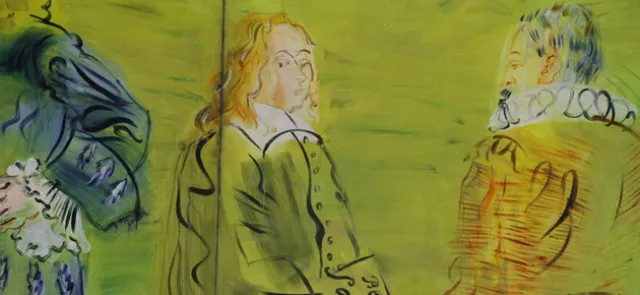
Blaise Pascal takes on induction
Although specialists still debate the origins of proof by induction, they often agree that Blaise Pascal's Traité du triangle arithmétique (Treatise on the Arithmetical Triangle) was the first work to set it out explicitly. A guided tour of a landmark in the history of proof.
Heron's algorithm
Heron of Alexandria is known for a famous formula that gives the area of a triangle without requiring its height. He also devised highly sophisticated mechanisms and an extraordinarily efficient recursive method for approximating the square root of a positive number.

Iterative methods for solving equations
Sequences, including recursively defined sequences, arise in many areas of mathematics. This is true of numerical methods for solving equations, which are in fact iterative methods—hence the presence of sequences.