Let's work in the Euclidean plane and mark two distinct points, O and I. As usual, we introduce a right-handed orthonormal coordinate system. The simplest approach is to use our two points to define it: O is the origin, and I has coordinates (1, 0); this completely determines the coordinate system. Our puzzle is geometric: using only a ruler and compass, can we reach every point in the plane in finitely many constructions? The question seems daunting. But our coordinate system lets us translate the geometric problem into one about the coordinates of points—and hence about numbers.
Keeping our bearings
---------------------
Constructing the coordinate system presents no difficulty. Starting from O and I, we draw the line (OI), followed by the line through O perpendicular to (OI). On this line, we then mark the point J such that OI = OJ. All these steps can be performed with a ruler and compass.
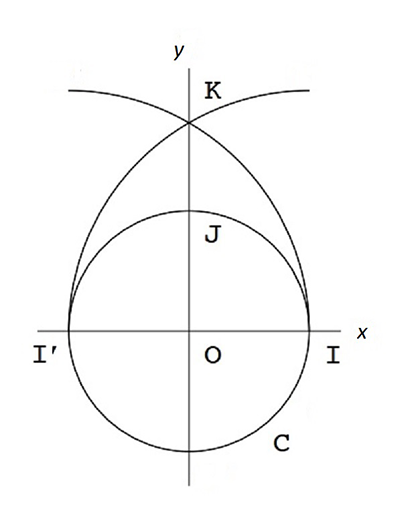
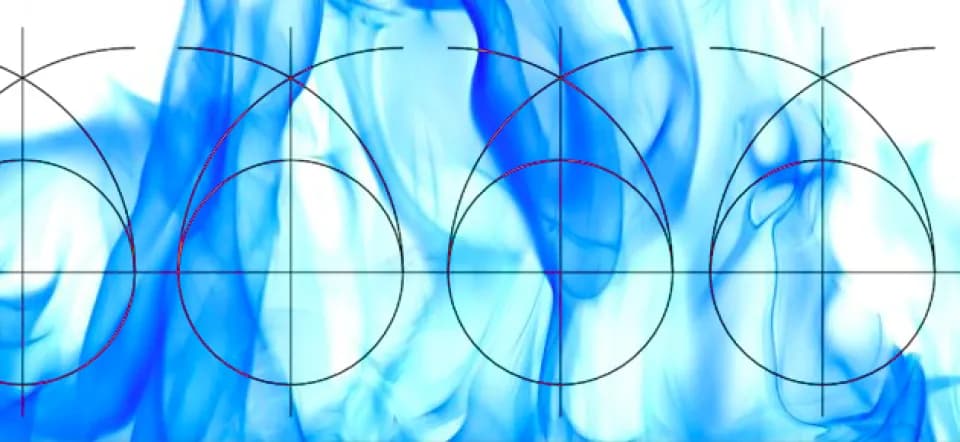
Here are the steps in detail: draw the line (OI); draw the circle C with center O and radius OI (this circle meets the line (OI) at I’); draw the circle with center I and radius II’, followed by the circle with center I’ and the same radius (they meet at K); draw the line (OK), which is the line through O perpendicular to (OI) (it meets the circle C at a point J). We then take the orthonormal coordinate system defined by the point O and the vectors and .