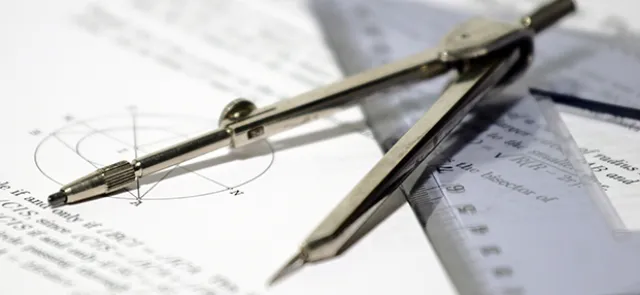
The expression "with straightedge and compass" evokes instruments and figures to be handled and arranged. Yet geometric constructions are closely bound up with a systematic ordering of knowledge, regarded as essential in education until the 1980s. This ordering has changed over time, giving rise to a wide variety of constructions. In the 1900s, for example, the set square supplanted the compass in the geometry of transformations. To illustrate the diverse relationships between instruments, figures and knowledge, compare the constructions of a perpendicular and a line parallel to a given line.
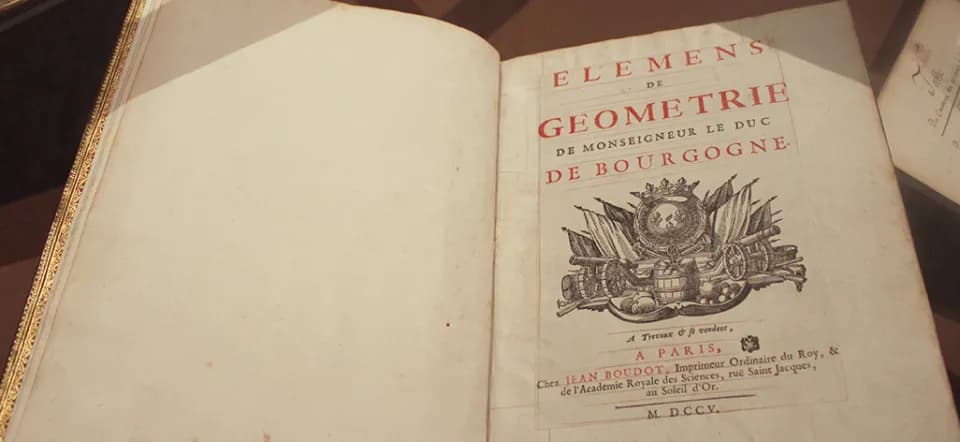
Geometry teaching in France broke with Euclid's Elements (see the Brief "Giving Euclid his due") following the publication in 1667 of a textbook for the Port-Royal Schools, Antoine Arnauld's (1612–1694) Nouveaux Éléments de géométrie. His ideas were taken up in Bernard Lamy's (1640–1715) Éléments de géométrie, which went through eight new editions between 1680 and 1765. Some of them remained part of elementary geometry teaching in France until the 1960s.
Arnauld criticized Euclid's Elements for failing to follow "the natural order", which proceeds from simple to composite figures, and for using composite figures to prove propositions about simple ones—for example, to construct a perpendicular. Book IV begins with simple figures: the straight line, the circle and then perpendicular lines. The circle is defined through the motion of a ray about its endpoint, and the compass is the "machine" used to draw it.
Arnauld: simple figures and distance
-------------------------------------
Arnauld introduced the notion of distance into geometry to give a "more exact definition of the perpendicular": a line through the midpoint of segment AB, with another point C equidistant from A and B, is the perpendicular bisector of segment AB, and every other point on the line, such as D and E, is likewise equidistant from A and B. This definition therefore rests on an axiom. It does not use angles, which are introduced later through the measurement of circular arcs, and provides a "very easy" way to dispense with triangles.