In antiquity, Archimedes defined "his" spiral by means of two motions (see "Les spirales") and studied it geometrically. In the 1630s, the cycloid and the trochoid were viewed as trajectories and studied through kinematics. The cycloid (see "Des roues et des routes adaptées") inspired fruitful new methods and later served as a testing ground for the emerging methods of infinitesimal calculus. Mathematicians discovered many geometric properties of the two curves, but also showed that they describe natural phenomena, making them all the more remarkable.
Mersenne and the wheel paradox
--------------------------------
In the 1620s, Marin Mersenne became interested in the pseudo-Aristotelian wheel paradox: two circles cover distances proportional to their diameters, yet cover the same distance when they are rigidly joined and share the same center.
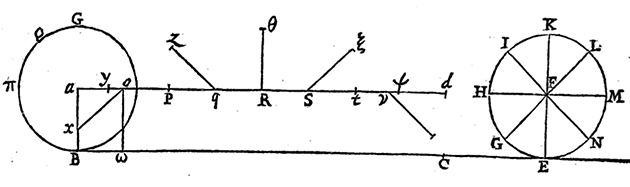
He approached the paradox by asking what curve is traced by a point on the circumference of a rolling circle. In his 1634 Questions inouïes, he wrote that it was "half an ellipse", but asked Gilles de Roberval to assess this answer. How could one tell whether the curve was an ellipse? In January 1637, Roberval replied with a point-by-point construction of the curve (see the figure below), announcing that "this line is neither an ellipse nor any of the curved lines found in our books; on the contrary, it has properties of its own, all of which I would describe if I had enough leisure".