Following Zeno’s paradoxes, the ancient Greeks ruled out any appeal to infinity, conceiving it, like Aristotle, only as potential: a line segment can be divided into ever smaller pieces; the mental process has no theoretical end, yet it can never actually be continued indefinitely.
The use of actual infinity—that is, infinity present "for real"—returned to favour much later, notably through the efforts of Bonaventura Cavalieri (1598–1647) and his method of indivisibles, which he presented in Geometria indivisibilibus continuorum nova quadam ratione promota, published in 1635. The method had, however, already been used by Gilles Personne de Roberval, as the French mathematician recalled in a June 1647 letter to Evangelista Torricelli (1608–1647; see FOCUS).
Roberval used this method to study the area under an arch of a cycloid, the "star" curve of the day, which gave mathematicians an opportunity to move beyond the theorems of classical geometry and pave the way for infinitesimal calculus.
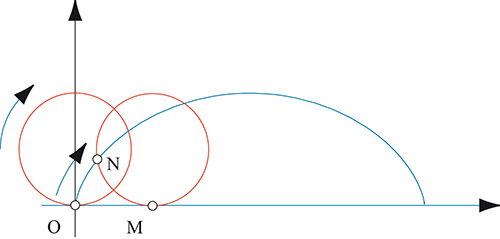
Because the wheel rolls without slipping, the lengths OM (measured in the positive direction to the right of O) and MN (measured along the circle tangent to the ground at M) are equal.