



Hervé Lehning
90 articles published in Tangente
 Math for everyoneN°80Nov 18, 2021
Cryptology revisited
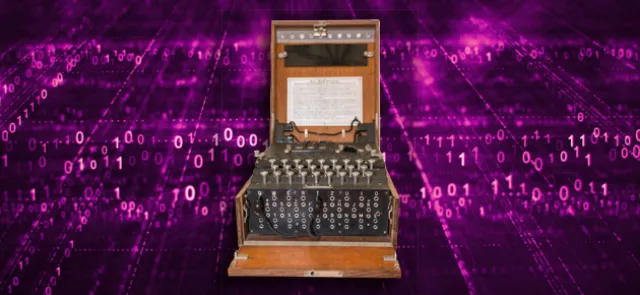
Groups were first used in cryptography in the 1920s and 1930s. The best-known example is the breaking of the Enigma machine. In the 1970s, groups opened the way to new encryption methods, including RSA and elliptic-curve cryptography.
Read → Math for everyoneN°80Nov 18, 2021
The Erlangen program
On his appointment as a professor at the University of Erlangen in 1872, Felix Klein, then only 23, presented a research program in geometry that has since become known as the "Erlangen Program." The concept of a group lies at its heart.
Read → Math for everyoneN°199Apr 14, 2021
Art, virtual tokens and blockchain
The best-known blockchain is used to verify ownership of bitcoins in a way that is, in principle, tamper-proof.
Read → Math for everyoneN°199Apr 13, 2021
The Zodiac's encrypted messages
At the turn of the 1970s, a serial killer was at large in California. What set him apart was that he communicated with the police through seventeen letters, four of them encrypted. The first was deciphered in 1969; the second has only just been cracked. These cryptograms put a new spin on classic cryptographic methods.
Read → N°77Feb 18, 2021
Vectors and matrices
Rectangular arrays of numbers can be added and multiplied. That is when they become matrices.
Read → N°77Feb 18, 2021
Digital watermarks
No doubt your Internet searches have turned up images you liked but could not use because they were overlaid with a translucent image credit.
Read →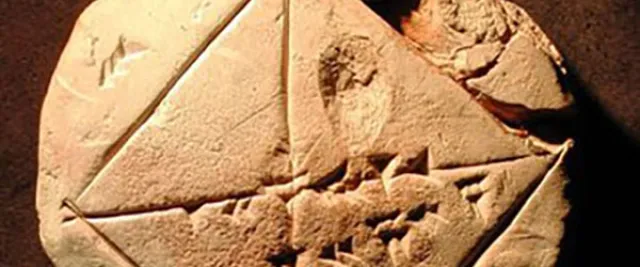 Math for everyoneN°197Dec 03, 2020
The Euclidean revolution
Some profound results, such as Pythagoras' theorem, predate any awareness of mathematics as a science. Rather, once theorized and proved, these results gave rise to this science.
Read → Math for everyoneN°76Nov 04, 2020
Proving a program
Writing a computer program is one thing. Proving that it actually produces the expected result is another! One major advantage of recursion is that it produces programs whose correctness is easy to prove. There is a link between writing a program and proving it correct.
Read →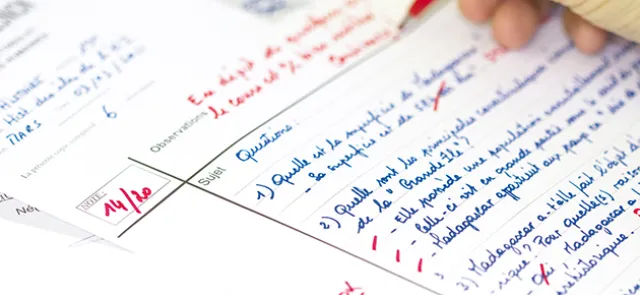 Math for everyoneN°195Jul 16, 2020
Without a standard…
It is easy to measure the distance between two points in the plane using a ruler, or to weigh something using scales. Measuring areas or volumes requires a command of integral calculus. But what about concepts for which comparison with a standard is difficult, such as happiness?
Read → Math for everyoneN°193Mar 19, 2020
Approximating functions efficiently
Most physical phenomena involve transcendental functions such as the exponential and trigonometric functions. To minimize computation times, we try to replace them with polynomials.
Read → Math for everyoneN°192Jan 22, 2020
Gödel's incompleteness theorems
In mathematics, although there are many conjectures and hypotheses, it is generally assumed that any well-formed statement must have either a proof or a refutation. Kurt Gödel showed that this is not so. His proof uses self-reference.
Read → Math for everyoneN°192Jan 22, 2020
The Gibbs phenomenon
When an image is compressed, it not only becomes slightly blurred: wherever there is strong contrast, its discontinuities are accentuated. This is known as the Gibbs phenomenon, and understanding it requires knowing how a wave can be decomposed into harmonics.
Read →