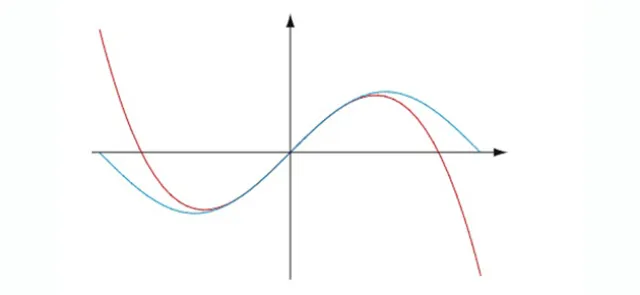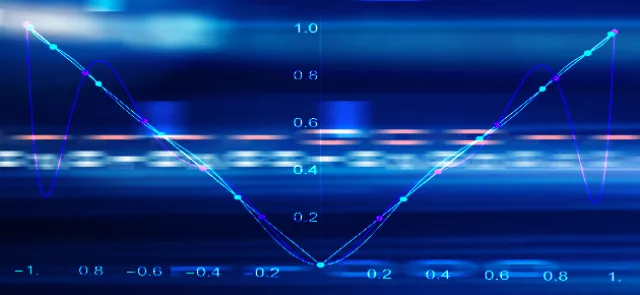
What computational tools do we have available, with or without a computer? Over the real or complex numbers—and even in more abstract fields—we can perform four elementary operations: addition, subtraction, multiplication and division. If a variable x is involved, this gives us rational functions—that is, polynomials and their quotients. The question then is: can any function be approximated by a polynomial?
Approximating a function
---------------------------------
Stated in such general terms, the answer is of course no. Conditions must be imposed on both the function and its domain. The simplest theorem on the subject is due to the German mathematician Karl Weierstrass: a function f continuous on a closed interval [a, b] can be approximated as closely as desired by a polynomial P.