The journey could be a very long one, given the sheer number of famous and useful mathematical inequalities. Even if we confine ourselves to the "simplest," we already encounter some "stars": powerful, important inequalities.
A for Aristarchus's inequality
--------------------------------
If α and β are the measures of two acute angles, in degrees or radians, and β < α, then:
It is named after the Greek astronomer Aristarchus of Samos, who believed, seventeen centuries before Copernicus, that the planets revolved around the Sun.

Aristarchus of Samos (c. −310–c. −230), as depicted in
Andreas Cellarius's Harmonia Macrocosmica (1660).
AF for the mean value inequality
---------------------------------------------
One of the fundamental theorems of differential calculus for functions taking values in is the Mean Value Theorem. It generalizes Rolle's theorem, proved in 1691 by Michel Rolle (1652–1719). It says this: if a function f is defined on an interval [a, b] (with a < b) and takes values in , and if it is continuous on [a, b] and differentiable on (a, b), then there exists c in (a, b) such that f (b) − f (a) = (b − a) f’(c).
In this modern form, it was proved in 1823 by Augustin-Louis Cauchy (1789–1857). The theorem can also be written as an inequality. If f is continuous on [a, b] and differentiable on (a, b), and if there is a constant M ≥ 0 such that | f’(t) | ≤ M for every t in (a, b, then the following mean value inequality holds:
| f (b) − f (a) | ≤ (b − a) × M.
The Mean Value Theorem does not extend to vector-valued functions—that is, functions taking values in (with n ≥ 2). The mean value inequality, however, does extend, and this result alone is more than sufficient for most applications.
Bern for Bernoulli's inequality
-----------------------------------
It states that, for every integer n strictly greater than 1 and every real number x greater than or equal to −1, we have (1 + x)*n ≥ 1 + nx*.
Stated by Jacob Bernoulli (1654–1705) in 1689 in connection with an interest calculation, it had probably been established earlier. It can be proved by induction on n. The inequality is true for n = 2: (1 + x)2 = 1 + 2x + x2 ≥ 1 + 2x, since x2 ≥ 0. Suppose it is true for some fixed n; we therefore have (1 + x)*n ≥ 1 + nx*.
Now (1 + x)*n*+1 = (1 + x)*n(1 + x) ≥ (1 + nx)(1 + x*) by the induction hypothesis; then, on expanding:
(1 + x)*n*+1 ≥ 1 + (n + 1)x + nx2 ≥ 1 + (n + 1)x, since nx2 ≥ 0. The result is therefore true for n + 1. By induction, it is true for every n.
This inequality can be generalized by replacing the integer n with a real number r satisfying the analogous condition r ≥ 1. Differential calculus is then needed to prove the new inequality.
Berns for Bernstein's inequality
------------------------------------
It concerns polynomials over the complex numbers and their derivatives. If P is a complex polynomial of degree at most n and k is an integer, then:
The maxima are attained for complex numbers with modulus at most 1. Equality is attained by the polynomial P(z) = *azn*. This inequality was obtained in the 1910s by Sergei Natanovich Bernstein (1880–1968) during his research in approximation theory.
CS for the Cauchy–Schwarz inequality
--------------------------------------
First proved by Cauchy and published in 1821, it concerns two collections of real numbers: x1, x2… and *xn on the one hand, and y*1, y2… and *yn* on the other. The inequality is:
It was subsequently generalized to integrals by the Russian mathematician Viktor Yakovlevich Bunyakovsky (1804–1889) and the German mathematician Hermann Amandus Schwarz (1843–1921); see the article ["The Cauchy–Schwarz inequality".
E for Euler's inequality
---------------------------
If r and R denote the respective radii of the incircle and circumcircle, then 2r ≤ R. This inequality is named after Leonhard Euler (1707–1783), who published it in 1765. It had, however, been published before then. Equality holds when the triangle is equilateral.
FM for the Markov brothers' inequality
--------------------------------------
No, not the Marx Brothers, so familiar to film buffs, but the "Markov brothers": more precisely, Andrey Andreyevich (1856–1922) and his brother Vladimir Andreyevich (1871–1897), both Russian mathematicians. The former is better known for his research on stochastic processes, which led to the notion now called a Markov chain. The inequality bearing their name concerns polynomials and their derivatives. If P is a real polynomial of degree at most n and k is an integer, then:
In the 1890s, Andrey proved the inequality for k = 1, and Vladimir generalized it to every integer k. Equality is attained when P is a Chebyshev polynomial. This inequality does not contradict Bernstein's inequality (see above), since the maximum values here are taken over the real interval [−1, 1], rather than over the unit disk in the complex plane.
H for Hölder's inequality
-----------------------------
This inequality was discovered in a slightly different form in 1888 by the British mathematician Leonard James Rogers (1862–1933), but it was named in honor of Otto Ludwig Hölder (1859–1937), who provided another proof and published it in 1889.
If x1, x2… *xn and y*1, y2… *yn are real numbers, and if p and q* are real numbers strictly greater than 1 such that then:
\begin{align} &| x_1y_1+x_2y_2+\cdots +x_ny_n| \nonumber\\\ &\leq (| x_1|^p+| x_2| ^p +\cdots + | x_n| ^p\big )^{1/p} (| y_1| ^q+| y_2| ^q+\cdots +| y_n| ^q\big )^{1/q}.\nonumber \end{align}
This generalizes the Cauchy–Schwarz inequality, which is recovered by taking p = q = 2. There is also a version for series and various versions for integrals. For example, if f and g are integrable functions on the interval [a, b], and if p and q are real numbers strictly
greater than 1 such that then:
HH for the Hermite–Hadamard inequality
---------------------------------------
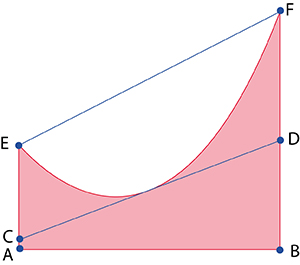
If a function f is convex on the interval [a, b], it is integrable there (in the Lebesgue sense), and its integral satisfies the inequalities
This inequality was discovered in 1883 by Charles Hermite (1822–1901) and independently proved ten years later by Jacques Hadamard (1865–1963). It is one of the fundamental inequalities associated with convexity. It has an obvious graphical interpretation: the first term in the inequality is the area of trapezoid ACDB, the integral equals the area of the red region, and the last term is the area of trapezoid AEFB.
I for the isoperimetric inequality
-----------------------------------
The problem, posed as early as the 9th century BCE, is to find an inequality relating the area enclosed by a closed curve to its perimeter, and then to find the closed curve with the greatest area for the smallest perimeter. If Δ is the area enclosed by the curve and p its perimeter, then:
p2 ≥ 4πΔ.
Equality holds for a circle (see the article "Dido's problem").
I.A.G. for the arithmetic–geometric mean inequality
------------------------------------------------
This inequality concerns the arithmetic and geometric means of n non-negative real numbers, x1, x2… and *xn*. It can be stated simply (see the article "A Story of Well-Ordered Means") as:
J as in Jensen's inequality
------------------------------
This inequality is closely tied to convex functions (see page 18). If f is convex on an interval I, x1, x2… *xn are real numbers in I, and λ*1, λ2… *λn are non-negative real numbers such that λ*1 + λ2 + … + *λn* = 1, then:
f (λ1x1 + λ2x2 + … + *λnxn) ≤ λ*1 f (x1) + λ2 f (x2) + … + *λnf (xn*).
It was proved in 1906 by the Danish engineer Johan Ludwig William Valdemar Jensen (1859–1925), an amateur mathematician who built on Otto Hölder's work. Like many other inequalities, it also has an integral form.
Jo as in Jordan's inequality
------------------------------
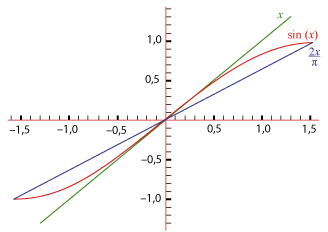
Named after the French mathematician Camille Jordan, this inequality is particularly easy to visualize. For x with absolute value less than π/2, we have:

Marie Ennemond Camille Jordan (1838–1922).
M as in Minkowski's inequality
--------------------------------
Like Hölder's inequality, it concerns real numbers and extends to series and integrals. If x1, x2… *xn and y*1, y2… *yn are real numbers, and if p* is a real number greater than or equal to 1, then:
\begin{align} &(| x_1+y_1| ^p+| x_2+y_2| ^p+\cdots +| x_n+y_n| ^p)^{1/p} \nonumber \\\ & \leq (| x_1| ^p+| x_1| ^p+\cdots +| x_n| ^p)^{1/p} \nonumber\\\ & +(| y_1| ^p+| y_1| ^p+\cdots +| y_n| ^p)^{1/p}.\nonumber \end{align}
For p = 1, this follows from the triangle inequality; for p > 1, it follows from the convexity of the function that maps x ≥ 0 to *xp*, together with Hölder's inequality.
It is named after the German mathematician Hermann Minkowski (1864–1909), known for his research in the geometry of numbers, convexity and spacetime (the four-dimensional space underlying the general theory of relativity developed by Albert Einstein).
S as in Schur's inequality
----------------------------
If x, y and z are non-negative real numbers and r is a strictly positive real number, then:
*xr(x ‒ y)(x ‒ z) + yr(y ‒ x)(y ‒ z) + zr(z ‒ x)(z ‒ y*) ≥ 0.
It is named after the Russian mathematician Issai Schur (1875–1941), whose name is attached to a great many mathematical results.
Ch as in Chebyshev's inequality
-----------------------------------
Let x1, x2… *xn and y*1, y2… *yn be real numbers such that x*1 ≥ x2 ≥ … ≥ *xn and y*1 ≥ y2 ≥ … ≥ *yn*. Then:
\begin{align} & \frac{1}{n}(x_1y_1+x_2y_2+\cdots + x_ny_n)\nonumber \\\ &\leq \frac{1}{n}(x_1+x_2+\cdots +x_n)\times \frac{1}{n}(y_1+y_2+\cdots +y_n). \nonumber \end{align}
Other inequalities hold when the sequences x1, x2… *xn and y*1, y2… *yn* are increasing or decreasing (see the article "Chebyshev and monotone sequences"). This should not be confused with the Bienaymé–Chebyshev inequality (see also the article "In probability: the Bienaymé–Chebyshev inequality").
Tri as in triangle inequality
----------------------------------
Surely the queen of inequalities! First appearing in Euclid's Elements around 300 BC, it states that in a triangle ABC, the length of any side is less than or equal to the sum of the lengths of the other two: AC ≤ AB + BC (see page 10). In everyday language: the shortest path between two points is a straight line!
This inequality underpins the mathematical notion of distance (see Les Distances, Bibliothèque Tangente 81, 2023).
We as in Weitzenböck's inequality
-----------------------------------
In a triangle with side lengths a, b and c, and with area denoted by Δ, we have:
It is named after the Austrian mathematician Roland Weitzenböck (1885–1955).
By Heron's formula, named for the Greek mathematician Heron of Alexandria (1st century), the area Δ of the triangle is , where p is the triangle's semiperimeter, namely p = (a + b + c) / 2.
Wi as in Wirtinger's inequality
---------------------------------
Like one form of the Cauchy–Schwarz inequality and Jensen's inequality, it involves integrals, but is probably somewhat less familiar. Proved by the Austrian mathematician Wilhelm Wirtinger (1865–1945), it has several forms that can be shown to be equivalent. Under certain assumptions, it relates the integral of the square of a function to the integral of the square of its derivative.
Let f be a real-valued function defined on an interval [a, b] (where a < b). If it is of class C1 on [a, b] (that is, continuous and differentiable, with a continuous derivative), and if f (a) = f (b) = 0, then the following inequality holds:
Y as in Young's inequality
----------------------------
The simplest form of this inequality concerns real numbers: it states that if x and y are non-negative real numbers, and if p and q are real numbers strictly greater than 1 such that then
It was proved by the British mathematician William Henry Young (1863–1942), to whom we also owe the Taylor–Young theorem, which generalizes the mean value theorem. Several proofs are known, one of which uses Jensen's inequality. This inequality, too, extends to an integral form.