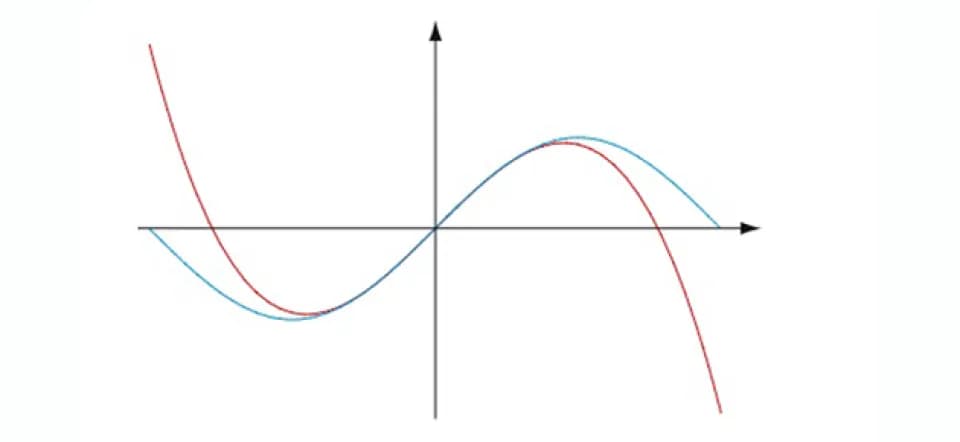
The polynomial interpolation problem is as follows: a function is known through its values y0, y1, y2… yN at N + 1 points x0, x1, x2… xN, and we seek a polynomial P with the same values at the same points—that is, such that P(*xi) = yi for every i* between 0 and N.
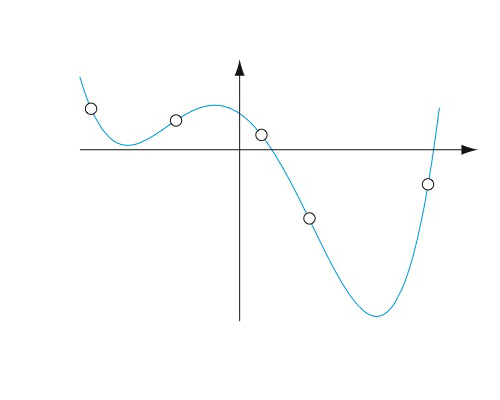
Through any five points there passes exactly one curve whose equation is a polynomial of degree at most 4.
This condition gives one equation for each point, hence N + 1 equations. A priori, P can be determined uniquely if it has the same number of parameters. This is the case if P is required to have degree at most N (one less than the number of points). The problem then amounts to solving a linear system with as many equations as unknowns, which, barring exceptional cases, always has a unique solution.
To make this more concrete, let us take three distinct points (x0, y0), (x1, y1) and (x2, y2), and seek a quadratic polynomial of the form P (x) = ax2 + bx + c, such that P (x0) = y0, P (x1) = y1 and P (x2) = y2. The problem amounts to solving the following system: