In mathematical modelling, equations derived from real-world phenomena generally have no explicit solution expressible in terms of elementary functions. Approximation techniques and numerical methods must therefore be used.
This is true, for example, of certain differential equations. The methods generally involve calculating the value of the solution only at specified points.
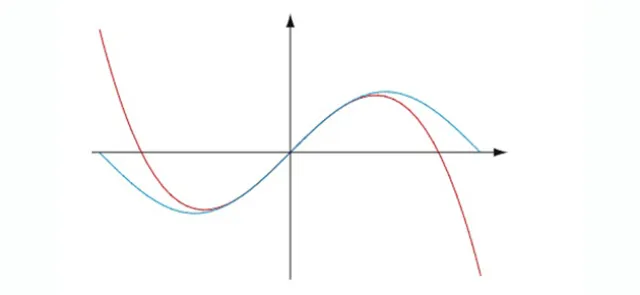
Approximation theory is a field of applied mathematics in which "complex" functions can be approximated by familiar, "simple" functions that approximate them to a prescribed degree of accuracy. Here, "simple" means that computations can be performed via simple algorithms that are fast and stable. The focus is then on methods for estimating function values within an acceptable margin of error.
Approximating with polynomials
----------------------------------
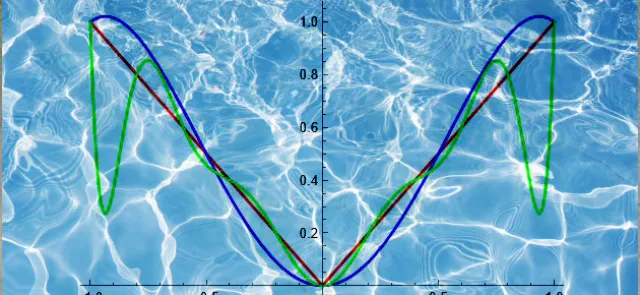
The Weierstrass approximation theorem states that every continuous function defined on a closed interval can be uniformly approximated, as closely as desired, by a polynomial. It thus demonstrates the power of polynomial approximation. For this reason, and because of their simplicity—they require only addition and multiplication—polynomials are often the first choice for approximating functions.