



Daniel Lignon
91 articles published in Tangente
 Amazing MathN°229Apr 22, 2026
Mersenne primes
The search for Mersenne primes very quickly leads us to examine gigantic numbers.
Read → CuriosityN°229Apr 22, 2026
A bug in 2038?
A massive bug related to the way computers represent large numbers looms on January 19, 2038, at 3:14:08 a.m.
Read → Amazing MathN°229Apr 22, 2026
The Boltzmann equation: the triumph of statistics
Formulated in 1872 by the Austrian physicist Ludwig Boltzmann (1844–1906), this equation describes how a gas or fluid evolves toward equilibrium. It bridges molecular collisions at microscopic scales and the macroscopic world.
Read → History and CultureN°229Apr 22, 2026
Skewes's numbers
Skewes's numbers are among the large numbers encountered in arithmetic.
Read →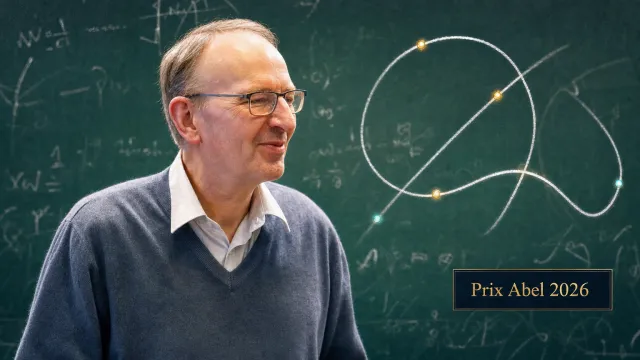 N°229Apr 22, 2026
The 2026 Abel Prize
Awarded annually by the Norwegian Academy of Science and Letters since 2003, the Abel Prize is one of mathematics’ most prestigious honors: for many, it is the field’s equivalent of a "Nobel Prize."
Read → Math for everyoneN°227Dec 15, 2025
And even vampires
Yes, vampire numbers really do exist! And they have fangs!
Read → Math for everyoneN°227Dec 15, 2025
Parasites
How do you multiply 105,263,157,894,736,842 by 2? Simple: just move the final digit, 2, to the front of the number, giving 210,526,315,789,473,684. And there you have it!
Read →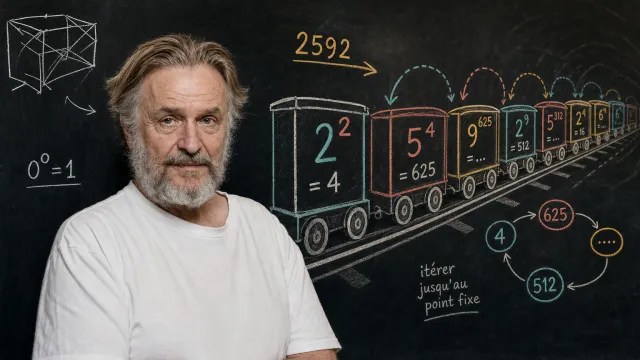 Math for everyoneN°227Dec 15, 2025
Conway's power trains
Power trains are iterated functions introduced by Conway.
Read → Math for everyoneN°227Dec 15, 2025
Staying prime... or not, in the face of digit changes
Unlike some composite numbers, it is hard to tell whether a number is prime just by looking at it. So what happens to a prime number if we make a change to its digits — for example, by permuting them or removing some of them? Can it stay prime? Or, on the contrary, does it stop being prime?
Read → Math for everyoneN°94May 12, 2025
Some conjectures in algebra
Here are a few conjectures proposed by Erdős that, despite some progress, remain unsolved...
Read → History and CultureN°94May 12, 2025
Friends you can count on
The married mathematicians Fan Chung and Ronald Graham were among Paul Erdős's closest friends. They took care of some of the practical aspects of Erdős's itinerant life.
Read → History and CultureN°94May 12, 2025
Collaborating with Paul Erdős
Much of Paul Erdős's work was carried out jointly with others. Gérald Tenenbaum, one of the French mathematicians who collaborated with him, agreed to discuss the methods of this unconventional mathematician.
Read →