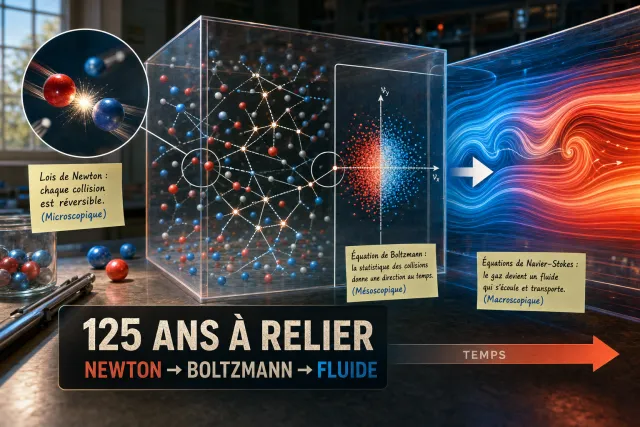

The Boltzmann equation's central challenge is to explain how irreversibility—entropy increasing over time—emerges from the microscopic laws expressed by Newton's equations, which are themselves reversible.
The equation involves the partial derivatives and integrals of a function of several variables. Although it can now be solved numerically, mathematicians have spent more than a century studying its properties and searching for exact solutions. One such mathematician is the French mathematician Cédric Villani, who received the Fields Medal in 2010 for his research on the subject. He gave a mathematical description of how a disturbed gas or plasma eventually settles back into equilibrium. His research made it possible to quantify this "relaxation" toward the resting state with precision, sharpening our understanding of the equation's internal structure.
Yet one link was missing from all this research: a proof that the Boltzmann equation can indeed be derived from Newton's laws over long timescales. Three American mathematicians—Yu Deng, Zaher Hani, and Xiao Ma—recently achieved this feat, which experts across the board hailed as a genuine tour de force, with a proof running to some two hundred pages! They proved that molecular chaos persists far beyond the timescales explored to date. Boltzmann's intuition is now a mathematical certainty.