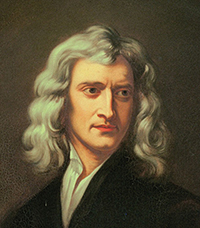
Isaac Newton.
Undoubtedly one of the greatest scientific figures of all time. His masterpiece, Philosophiæ Naturalis Principia Mathematica, appeared in 1687. In this 550-page book in Latin, in which he finally published ideas sometimes developed twenty years earlier, he did nothing less than establish classical mechanics: he revealed the forces of gravitation and the universal laws of motion, modelled them with mathematical equations, and laid the foundations of differential calculus, making it possible to state the fundamental principle of dynamics now taught in every high school. Yet Newton's revolutionary ideas did not prevail until the Age of Enlightenment, after numerous controversies had finally subsided.
-
From the apple to gravitation
-----------------------------
According to legend—as recounted by Newton's biographer and friend William Stukeley, following a conversation between them in 1726—it was around 1666 that the 24-year-old British scholar, watching an apple fall in his mother's garden in Woolsthorpe-by-Colsterworth, England, had a brilliant insight: the force of attraction that made the apple fall was the same force that kept the Moon in orbit around the Earth! The theory of universal gravitation was taking shape. Newton embarked on numerical calculations and verified that his insight agreed with the earlier observations of Galileo and Kepler. He postulated what we now call Newton's laws. In a mathematical tour de force, he managed to deduce from this postulate that the planets follow elliptical paths, thereby recovering Kepler's laws. At the same time, alongside the work of Leibniz, who is regarded as its co-founder, infinitesimal calculus was also taking shape, foreshadowing the concepts of limits and derivatives later formalized by Augustin Louis Cauchy, Leonhard Euler, Karl Weierstrass…
Newton's approach was remarkable: starting from observations and numerical data, he derived an abstract model, analysed it to confirm those observations, and then extrapolated from it, thereby gaining a detailed understanding of a natural phenomenon! The Principia Mathematica undoubtedly marked the beginning of the mathematization of science and of what became the general scientific method in mathematics: observe, model, analyse and simulate, with the aim of predicting, optimizing and controlling. For the first time, Galileo's thought was truly put into practice: "Nature is a book written in the language of mathematics."
Newton's scientific approach was strikingly modern: he accepted only mathematical relationships discovered through rigorous observation of phenomena. "Hypotheses non fingo", he liked to repeat ("I frame no hypotheses").
Around 1666, Newton therefore set out to test the law of gravitation he had just postulated against observation. Unfortunately, contemporary estimates of the Earth–Moon distance and the Earth's radius were too crude, and the data available to him suggested that our satellite should fall to Earth! Faced with this discrepancy, he abandoned his theory—for the time being. Only sixteen years later, in 1682, did he learn at the Royal Society in London that the Frenchman Jean-Félix Picard (known as Abbé Picard, 1620–1682) had determined a far more accurate value for the Earth's radius. With this value, Newton found that his theory did, after all, agree with observations!
This was the genesis of the Principia Mathematica. The scientific world was buzzing at the time, and the idea of an attractive force inversely proportional to the square of the distance between two bodies was in the air, notably in the work of Edmond Halley (1656–1742) and Robert Hooke (1635–1703). Hooke had clearly formulated the universal nature of gravitational attraction, but he lacked Newton's mathematical genius, which would have enabled him to formalize his ideas rigorously and recover Kepler's laws, including the fact that the planets follow elliptical paths. The two countrymen corresponded extensively—and also clashed bitterly…
Newton, who held a chair at Cambridge, had taken up Halley's work on celestial mechanics in 1677. In 1684, the young astronomer who would give his name to a famous comet asked Newton what path a body would follow if subjected to a force inversely proportional to the distance. Newton immediately replied that it would be an ellipse, as he had calculated twenty years earlier without publishing the result. He sent the young astronomer a few pages proving it. Impressed, Halley encouraged him to publish and provided some of the funding.
-
The comet returns
-----------------
The Principia Mathematica finally appeared in 1687, bringing Newton great international acclaim. Recognition came later in France, where Descartes's vortex theory prevailed: it held that the planets travelled through a kind of ether that kept them in orbit… This gave rise to bitter disputes between Newtonians and Cartesians. Only around 1750—thanks in particular to the efforts of Pierre Louis Moreau de Maupertuis, Alexis Clairaut, Voltaire and Émilie du Châtelet, as well as Diderot and D'Alembert's Encyclopédie—did Newtonian mechanics finally gain acceptance in France. In 1759, the return of Halley's comet, as predicted by Newton's theories, secured their final triumph.
Understanding Newton's laws made it possible to formulate the famous N-body problem mathematically: solving the differential equations governing the motion of bodies that interact gravitationally. This is a fundamental problem in mathematics and astronomy, which Newton tried unsuccessfully to solve for N = 3. A century later, building on Euler's work, Joseph-Louis Lagrange studied the restricted three-body problem, in which two bodies are "very massive"—the Sun and the Earth, for example—while the third has "negligible" mass compared with the other two, as would a stone, an asteroid or a spacecraft. He proved that, in a rotating coordinate system, Newtonian dynamics admits five equilibrium points, now known as the Lagrange points.
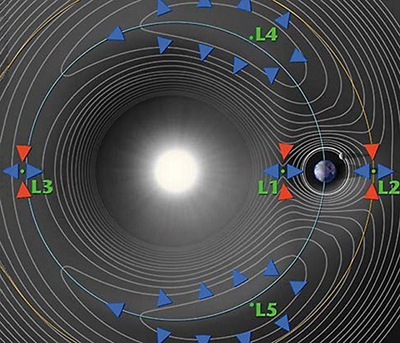
The fact that these are equilibrium points is valuable: it makes it possible to maintain a fixed configuration relative to two celestial bodies, and hence to design space-based observation sites. If an object is placed exactly at a Lagrange point, it remains there—in theory, at least…
That theoretical caveat raises the question of whether these equilibrium points are locally stable. As shown in the figure, which depicts orbits—possible paths of a stone in the Sun–Earth system—the points L1, L2 and L3 turn out to be inherently unstable, whereas L4 and L5 are stable. In practice, this means that if a pebble is placed near L4 or L5, it will begin to drift but will remain in that neighbourhood. By contrast, if it is placed very close to L1, L2 or L3, it will not remain nearby.
"In theory", if the pebble is placed exactly at L1, it does not move. In practice, however, the slightest disturbance—the solar wind, perturbations caused by other celestial bodies and so on—will dislodge it from L1, causing it to drift away sooner or later. The situation is similar to that of a stick placed on a table: when perfectly upright, it stays in position, but this equilibrium is unstable. At the slightest disturbance, it falls over.
-
Balancing a stick in your hand
------------------------------
At first sight, stability around L4 and L5 may seem like good news: place a spacecraft near one of these points and it will remain there. In fact, however, these points are surrounded by large quantities of dust and small celestial bodies that have become "trapped" in this potential well. Like a basin, it has, through the vagaries of astronomical events, collected these asteroids—including the famous Trojan asteroids in the Sun–Jupiter system—making it impossible for a spacecraft to remain in the area because inevitable collisions would quickly damage it.
The instability of L1, L2 and L3 is therefore good news after all, in a sense: these sites are "naturally clean"! But keeping an object near these Lagrange points requires control theory, particularly stabilization. Consider the stick again, but now imagine trying to balance it upright on a finger or in the palm of your hand, even if this means moving a little. Since the upright equilibrium is unstable, stabilization here means moving your hand slightly—exerting control—to compensate for small deviations from equilibrium and thus keep the stick close to its unstable equilibrium. For a spacecraft near an unstable Lagrange point, the idea is that a slight thrust—provided by solar panels, for example—is enough to keep it in the region of interest. This requires very little energy.

In the Sun–Jupiter system, the Trojan asteroids lie near the L5 Lagrange point.
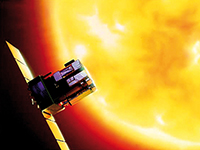
The L1 and L2 Lagrange points in the Sun–Earth system have long been used by space agencies, which station many spacecraft there. For example, the SOHO satellite has orbited L1—located about 1.5 million kilometres from the Earth towards the Sun—since 1996; its mission is to observe the surface of our star, its sunspots, solar flares and more. The successor to the Hubble telescope, known as JWST (James Webb Space Telescope), is due to be launched—in principle, in 2020—and placed in orbit around L2, an ideal position because sunlight will not interfere with it.
-
Periodic trajectories
---------------------
Drawing on theorems of Alexandre Lyapunov and Henri Poincaré, and on the theory of dynamical systems developed in the 1960s, mathematicians have uncovered unsuspected properties of the Newtonian gravitational field around the Lagrange points—properties that are remarkably useful in designing space missions. Around each Lagrange point, there are many periodic and quasi-periodic trajectories, the best known being halo orbits, which are deformations of circles. There are also Lissajous orbits of every kind. These surprising properties stem from the complexity of the gravitational field in the many-body problem. The corresponding trajectories are valuable because a spacecraft can be stabilized along such orbits at very little energy cost.

Stable invariant manifold (in green) generated by a halo orbit.
Most fascinating of all, each of these periodic orbits generates manifolds—stable or unstable—that are invariant. They are a kind of tube built around the periodic orbit that generates them, and behave like genuine "gravity currents", similar to ocean currents: place a pebble inside such a "tube" and it will begin to drift—quite slowly—with the current while remaining inside the tube. We can therefore use them to travel entirely free of charge, along routes that can be calculated exactly and are therefore predictable.
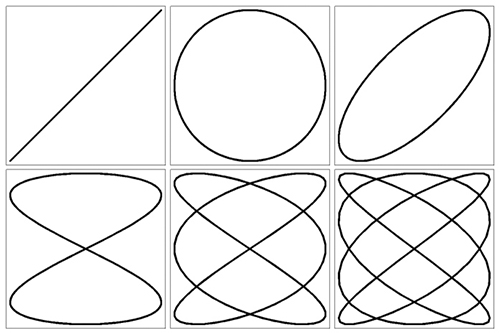
Halo orbits (top) and Lissajous curves (bottom).
-
Very low-cost travel
-------------------
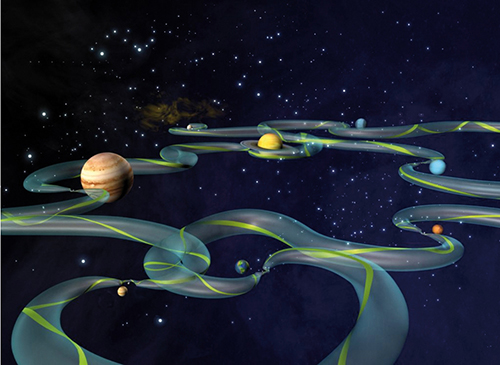
Artist's impression of gravity currents (invariant tubes).
Mapping gravity currents opens up the prospect of interplanetary space missions that require almost no energy. Low-cost travel is coming to interplanetary missions too! Like ocean currents, however, these currents provide slow transport, making them better suited to robotic missions. Alternatively, their propulsive effect must be combined with the use of an engine…
For example, using the L1 and L2 Lagrange points in the Earth–Moon system and the gravity currents they generate, we know how to travel from the Earth to the Moon almost "free of charge", except, of course, for the initial need to escape the Earth's gravitational pull. Once a spacecraft has been placed inside an invariant tube, we can bring it to within about 1,500 km of the Moon's surface in three to four months without using any fuel! In the near future, the international community might therefore agree to build a lunar base—probably at the Moon's north pole—to serve as a staging post for missions to Mars.
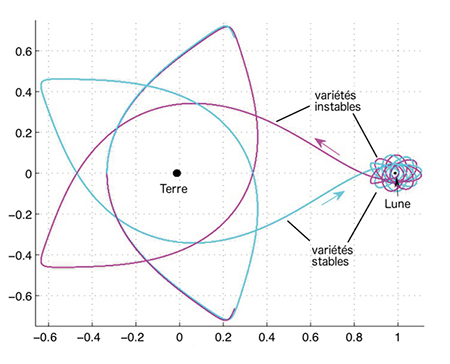
The Earth–Moon system.
Looking further ahead, we can design long-range interplanetary missions capable of visiting the moons of Jupiter or Saturn "at very low cost". The price to pay, however, is the journey time… Long-distance crewed missions will therefore be unable to rely solely on this network of gravity currents, but robots can be sent to explore the outer reaches of the solar system, and perhaps beyond.
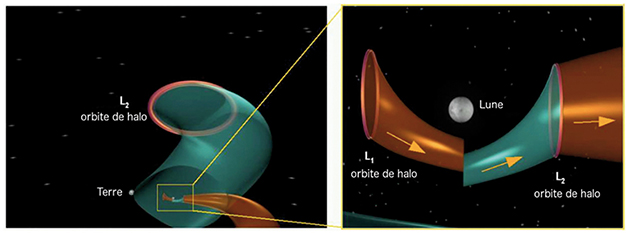
####

This text is based on a lecture given by Emmanuel Trélat on Wednesday, January 23, 2019, at the Bibliothèque nationale de France as part of the "Un texte, un mathématicien" series.

Emmanuel Trélat is a professor at Sorbonne Université (Paris-VI) and heads the Fondation Sciences mathématiques de Paris. He has received numerous awards, notably for designing the software now used for Ariane launch vehicles.