


Pandemics are not the only dangers threatening humanity. The orbits of many asteroids, known as Earth-crossing asteroids, intersect Earth's orbit, and a collision could have incalculable consequences for our planet. An ambitious international program is being set up to test our ability to alter the trajectory of such an object. The chosen target is Didymoon, a body 160 m in diameter orbiting Didymos, an asteroid 780 m in diameter. The pair passed eight million kilometers from Earth on November 13, 2003.
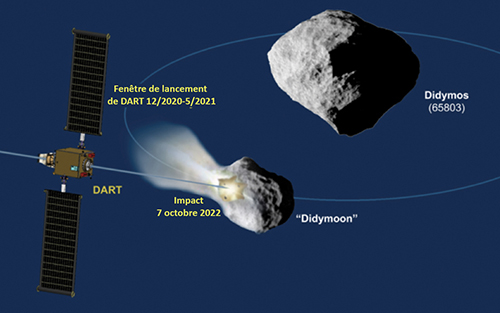
The operation will take place in two stages. First, in 2021, the US National Aeronautics and Space Administration (NASA) will send a spacecraft named DART, which is expected to strike Didymoon at 21,600 km/h in October 2022 and alter its orbit, when it is seventeen million kilometers from Earth. Then, in 2024, the European Space Agency (ESA) will launch another spacecraft. This second mission, named Hera, is led by Patrick Michel, a French ESA researcher. It will study the crater formed by the American missile using two tiny modules measuring around ten centimeters. Measurements taken by the various instruments carried aboard these craft should help identify ways to deflect an asteroid threatening our planet.