-
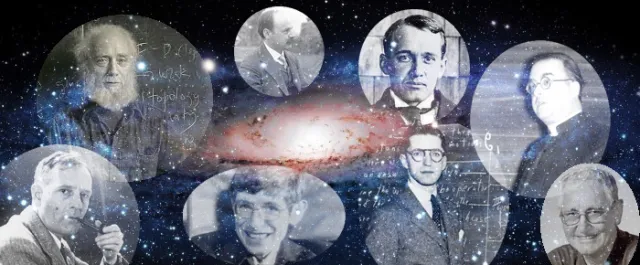
After counting the stars visible through his telescope when he pointed it in a few carefully chosen directions, he extrapolated his results to the entire Milky Way. The instruments have changed since then, but the approach remains the same! When researchers sought more accurate information about the astrometric properties (distance, parallax) and photometric properties (luminosity, color) of stars, the European Space Agency (ESA) used the Hipparcos and Gaia space telescopes in succession. Between 1989 and 1993, Hipparcos observed 118,000 stars; then, between 2013 and 2018, Gaia went further, observing 1,800,000,000 stars. These measurements made it possible to count the stars in several regions of the galaxy whose dimensions were known. By extrapolating to the entire galaxy, as Herschel had done, the researchers estimated that our galaxy contains between 200 and 400 billion stars.
How many galaxies are there in the observable universe?
------------------------------------------------
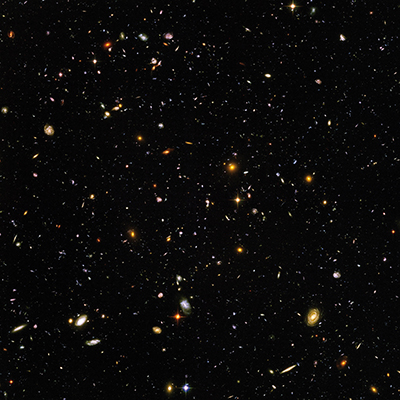
The light we receive from visible galaxies can only have been emitted since the Big Bang, which occurred 13.8 billion years ago. Yet because the universe is continually expanding, some of these galaxies may be much more than 13.8 billion light-years away. In the standard model of cosmology, the observable universe is a sphere centered on Earth with a radius of 46.5 billion light-years. To estimate the number of visible galaxies, NASA researchers used the Hubble Space Telescope. Between 2003 and 2004, it photographed a tiny region spanning a field just 0.04° wide. The final image, named the Hubble Ultra Deep Field, revealed about 10,000 galaxies in this region of space, even though it had appeared "empty." Extrapolating the results to the entire observable universe, the NASA researchers estimated that it contains approximately 1012 galaxies. Assuming an average of 100 billion stars per galaxy, we can estimate that there are at least 1023 stars in the observable universe.