



Movements and trajectories
A curve can be seen in its entirety as a static object, but also as the trajectory of a point moving in space. From dynamics to kinematics, curves naturally allow us to represent the movements of bodies, from the most voluminous celestial bodies to the most minute particles or light rays. Another link between theory and practice is materialized by mechanical systems, these sometimes astonishing assemblies that can be used to draw curves.
All articles in this folder

Modelling trajectories
The links between mathematics and the physical sciences are both ancient and profound. They find their most striking expression in the curves, trajectories and other loci obtained through experiment. Conic sections are especially prevalent, at every scale from the microscopic to the macroscopic.

The early history of the cycloid
It took decades to uncover the geometric properties of cycloids and trochoids. The scholars who studied them began with physical or practical questions before turning to these remarkable curves themselves.
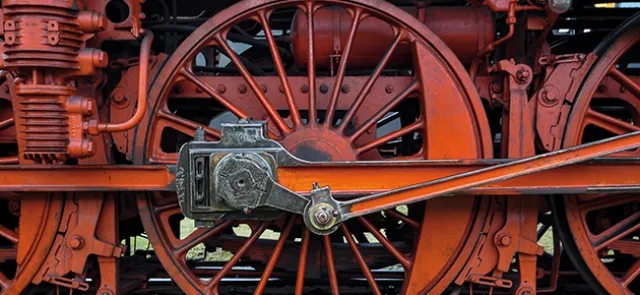
The endless variety of glissettes | Tangente
Roulettes do not exhaust the possibilities offered by plane-on-plane motion—or the geometric wonders hidden within it. Armed once again with drawing paper, tracing paper and pens, we continue our exploration with some somewhat overlooked curves: glissettes.

Improving the 200 m record with maths | Tangente
What if speed records could be improved by changing the shape of athletics tracks?

Deflecting an asteroid with mathematics | Tangente
An international team is tasked with studying the possibility of deflecting the trajectories of asteroids if there is a risk of collision with Earth.
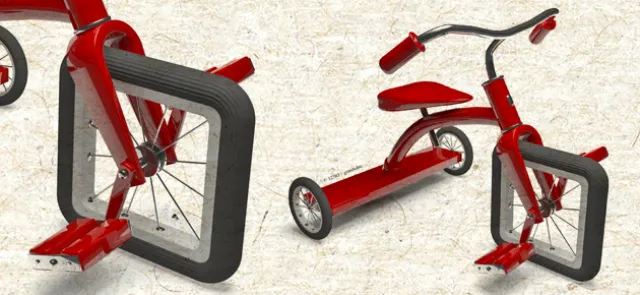
Wheels and roads to match
Surprisingly, wheel and road profiles can be tailored so that the wheel’s axle remains at a constant height, ensuring maximum comfort for the traveller.
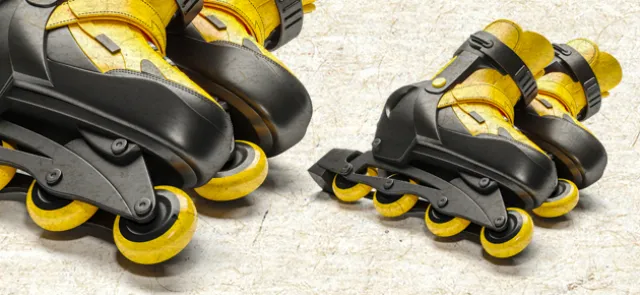
Graceful roulettes: epicycloids and cycloids | Tangente
Drawing paper, tracing paper, colored pencils, a little curiosity and some practical ingenuity... You now have everything you need to explore roulettes and rediscover a now-forgotten classic of dynamic geometry: plane-on-plane motion.
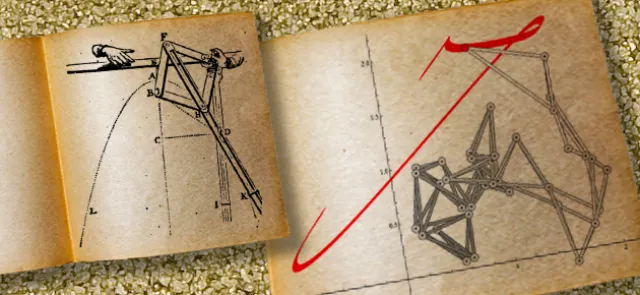
Drawing machines: building mathematical curves | Tangente
Viewed as geometric loci, curves have always been drawn on a physical surface using instruments—or even machines. The mechanical linkages devised for this purpose can faithfully reproduce the curve under study.