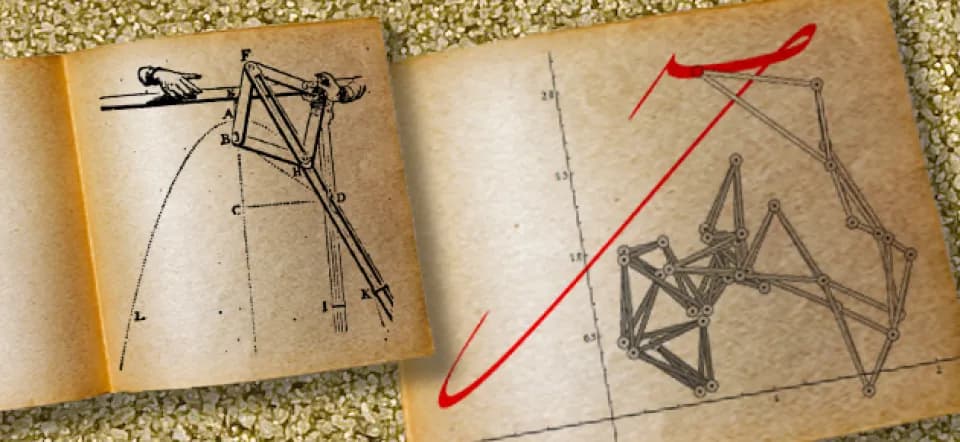
The simplest curve is the straight line, which we draw with a ruler (see la Droite, Bibliothèque Tangente 59, 2017). To draw a circle, we use a compass (see le Cercle, Bibliothèque Tangente 36, 2009). The Greeks used other curves, such as Diocles' cissoid, Nicomedes' conchoid and Hippias' quadratrix, to solve problems including squaring the circle and trisecting an angle (see the article "Curves beyond the compass"). While tackling the duplication of the cube in the 4th century BCE, Menaechmus discovered the three conic sections: ellipse, hyperbola and parabola. Later, Apollonius of Perga, a contemporary of Archimedes, made these curves famous under the name "conic sections." Are there machines that can draw conics?
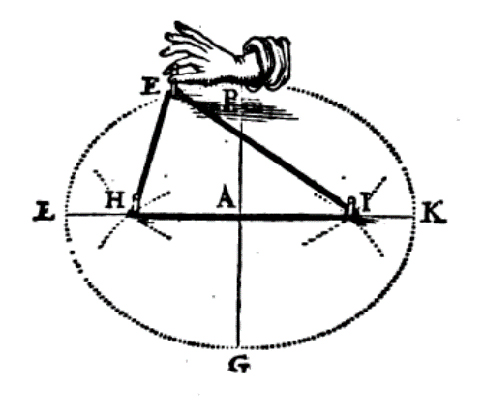
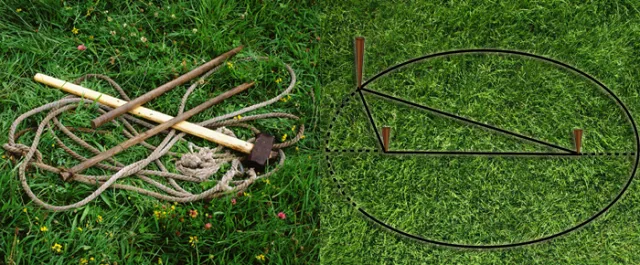
Drawing an ellipse using the gardener's method.
Drawing conics...
--------------------
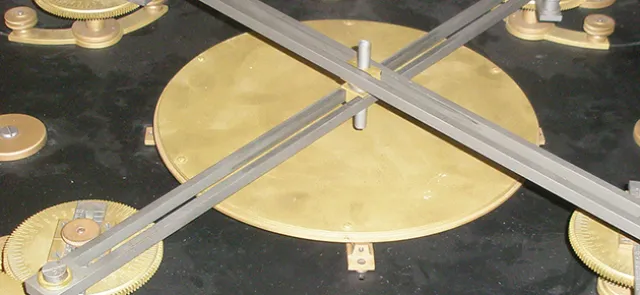
An ellipse can be drawn using the Archimedean ellipsograph (see Mathematical Models, Henry Martyn Cundy and Arthur Percy Rollett, Oxford University Press, 1961), also known in English as Archimedes' trammel (the word trammel means "shackle," explicitly evoking the mechanism's two prismatic grooves). Was this mechanism created by Archimedes in the 3rd century BCE? This seems unlikely, as none of his writings attest to such a construction. Yet he was a skilled engineer and probably met Ctesibius, the founder of the Alexandrian school of mechanics.