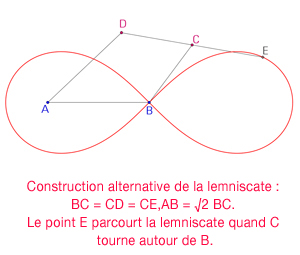
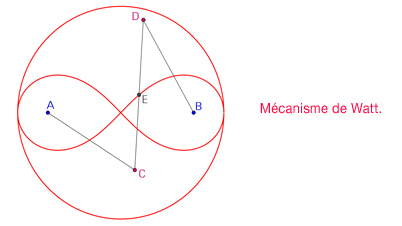
The invention of the steam engine revived an old problem: how could the piston's linear motion, driven by steam, be converted into rotation? The question dates back at least to the use of watermills: the wheel's rotation often had to be converted into linear motion, which is in fact the reverse problem. James Watt (1736–1819) would devise an approximate solution. Charles Peaucellier (1832–1919) and Lipman Lypkin (1846–1876) would provide an exact solution in 1864, followed by Harry Hart in 1875 and Alfred Kempe in 1876 (best known for his ultimately flawed "proof" of the four-color theorem).
A machine that can imitate your signature
--------------------------------------------
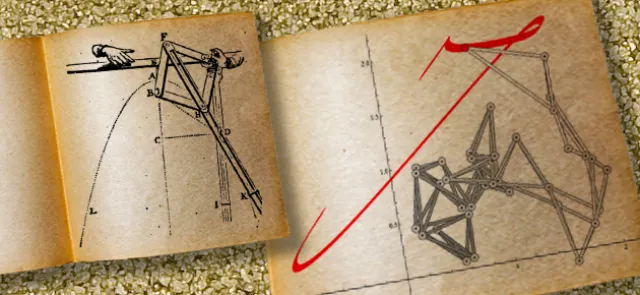
But doing mathematics also means generalizing. That is what Kempe did: he showed not only that lines could be drawn using linkages, but also that any algebraic curve could be drawn by a linkage mechanism (that is, rigid bars connected by pivot joints). This extraordinary result is Kempe's universality theorem. At a conference, the great American geometer William Thurston (1946–2012) summed it up as follows: "If your signature is a continuous sequence of curves (you do not lift the pen), then there is a mechanism that can reproduce your signature!" Admittedly, the machine might require hundreds of bars…