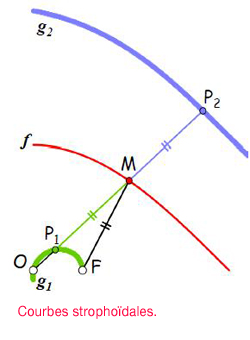
The notion of a locus seems to have originated with Hippias of Elis and his mechanical construction of a curve obtained as the locus of the intersection point of two moving line segments, one translating and the other rotating. This curve is called a trisectrix, because it provides a graphical method for trisecting an angle, and also a quadratrix by Dinostratus, because it can be used to square the circle. A strophoid is likewise a locus: a set of points that all share the same property.
The study of this family of curves, which began during the 17th century, appears in the works of many mathematical physicists, including Evangelista Torricelli in 1644 and Gilles de Roberval. In 1645, Roberval named these curves pteroids ("wing-shaped"), a name retained until the end of the 18th century. They were first renamed strophoids ("twisted in shape") in an 1837 work by the Italian mathematician Enrico Montucci of Siena.
-
Many different constructions
-------------------------------