Roulettes help us visualize the relative motion of a point on a sheet of tracing paper over a sheet of drawing paper (see the article "Graceful roulettes"). But plane-on-plane motion can take us even further!
Draw two curves C1 and C2 (the fixed curves) on the drawing paper, and two more curves C’1 and C’2 (the sliding curves) on the tracing paper. To obtain a point M1 on C1, move the tracing paper until C1 and C’1 are tangent, then slide C’1 along the stationary curve C1 until C2 and C’2 become tangent, if possible. As M1 moves, this produces a plane-on-plane motion in which C1 must remain tangent to C’1, and C2 to C’2. The resulting roulettes are more properly known as glissettes. The instantaneous center of rotation I, from which the fixed and moving centrodes can be obtained, lies at the intersection of the perpendiculars through the points of tangency.
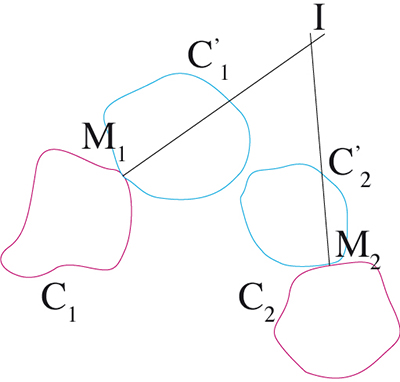
The fixed curves are shown in purple and the sliding curves in blue.
The fine art of handling tracing paper
----------------------------------