



Robert Ferréol
24 articles published in Tangente
 Math for everyoneN°227Dec 15, 2025
How long does a number persist?
Adding or multiplying together the digits of an integer is an activity a curious child might feel like doing. But they probably have no idea that it is the source of problems still unsolved in 2025!
Read →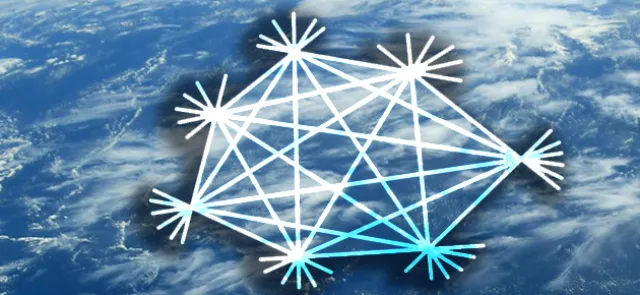 Math for everyoneN°94May 12, 2025
Two geometric jewels
Long after the 19th century, the golden age of geometry, Erdős took an interest in problems whose statements could appear in an elementary textbook. Among these are two jewels of elegance: the Erdős–Mordell theorem, which involves nothing more than a triangle, and the Erdős–de Bruijn theorem, which features only points defining lines.
Read → Math for everyoneN°221Dec 17, 2024
Ellipse snippets
There are several ways to construct an ellipse. Here are a few.
Read →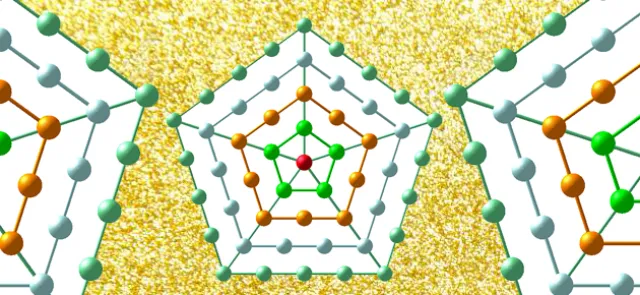 Math for everyoneN°92Dec 04, 2024
When polygons form numbers
All is number! The Pythagorean school established many properties of numbers from their geometric representations. First developed for triangles and squares, this way of arranging numbers was later extended to all kinds of polygons.
Read → Math for everyoneN°90May 07, 2024
One of them—or not…
A number for which, apparently, no definition involves a polynomial with integer coefficients has no reason to be algebraic. But that does not prove it is transcendental! Despite the many theorems on the subject, a great many numbers continue to resist classification.
Read → Math for everyoneN°216Feb 21, 2024
In the service of curves
Through the magic of analytic geometry, the properties of an algebraic formula find visual expression in the corresponding curves. Taylor expansions play an absolutely crucial role in this constant interplay.
Read → Math for everyoneN°87Aug 23, 2023
Ptolemy's little-known inequality
The Greek mathematician, geographer and astronomer Claudius Ptolemy discovered a theorem about quadrilaterals inscribed in a circle in the second century CE. His result is certainly far less famous than that of his compatriot Pythagoras, but it is every bit as beautiful.
Read → Math for everyoneN°212Jun 22, 2023
Pythagorean triangles
When the side lengths of a triangle form a Pythagorean triple, the triangle is called a Pythagorean triangle. Discover its properties...
Read → History and CultureN°211Apr 25, 2023
Stereographic projection
Since 2021, the Bourse de commerce in Paris has been open to the public, showcasing contemporary art from the Pinault Collection. Its superbly renovated interior offers mathematicians an opportunity to explore… stereographic projections!
Read →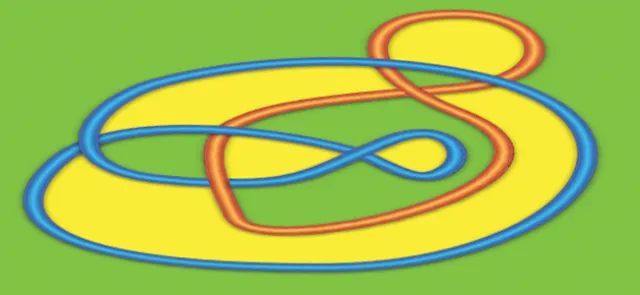 History and CultureN°211Apr 21, 2023
Links and graphs: a two-way connection
What do links and planar graphs have in common? They are connected by a relationship that associates a graph with any given link and, conversely, provides a simple way to encode—and therefore draw—any link using a graph.
Read →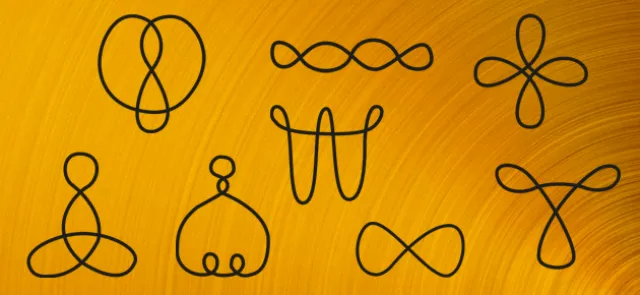 History and CultureN°211Apr 21, 2023
Identifying a knot by its Gauss code
A visual encoding introduced by Gauss to make knots easier to recognize and manipulate leads to surprising developments in combinatorics, algebra and topology. Armed with paper, pencil and a few pieces of string, let's explore this world.
Read → Math for everyoneN°84Nov 21, 2022
A remarkable line: the asymptote
A look back at some properties of asymptotes...
Read →