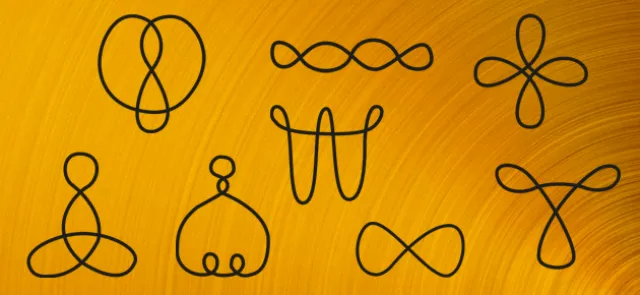
A link (or Celtic knot) is a finite collection of interlaced closed curves (the strands), entangled without intersecting one another. Such objects underlie many ornamental patterns in a variety of cultures. A link is generally represented by one of its projections onto a plane, positioned so that—as is always possible—each crossing in the diagram involves only two curves, with distinct tangents. Overpasses and underpasses are shown by erasing part of each strand where it passes underneath at a crossing.

A two-strand link.
A graph, by contrast, is a diagram in the plane consisting of points, called vertices, which may or may not be joined by lines, called edges, most often drawn as line segments. It is called a planar graph if it can be drawn so that no two edges cross.
A two-way relationship between planar graphs and links, brought to light in the late 19th century, makes links easier to study.