



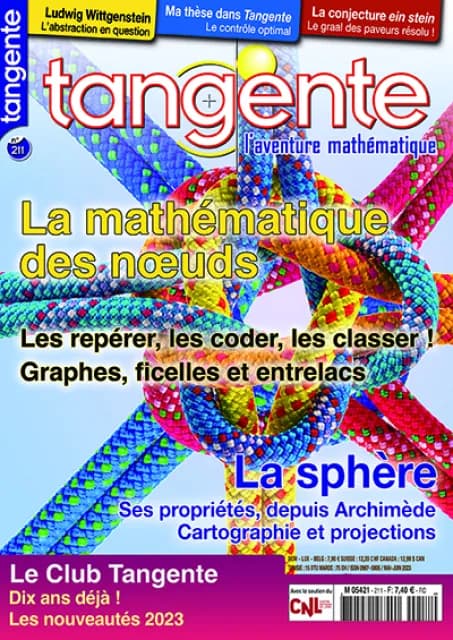
The mathematics of knots
This issue is not fully translated into English yet; only translated content is shown.
Read the French versionAll folders in this issue
The mathematics of knots
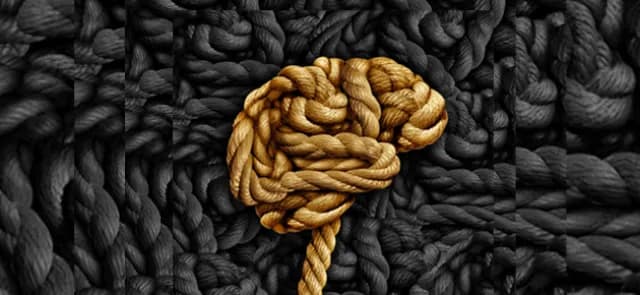
For millennia, sailors (and more recently climbers) have used knots to tie their ropes. Interlacements, already present in Roman decorative art, are found in Islamic and Celtic motifs. At the end of the 19th century, Tait and Thomson, through a hypothesis – which proved to be false – of chemical bonds that would interlace, brought knots into the realm of mathematics. Do you like tying strings or untangling the hanks of your balls of wool? Knot theory is made for you! Mathematical challenges are not lacking there. Without knowing it, Gauss, in studying certain curves, had laid the groundwork for this theory, which makes it possible to generate knots systematically, to classify them, to understand their connections with graph theory or to distinguish them 'at first glance' with the help of a complete invariant... which still remains to be constructed.
The sphere
The sphere is one of the most elementary objects in geometry. To study it, since Archimedes, treasures of ingenuity have been deployed. The most famous of them is the one we inhabit, but it took centuries to become convinced that the Earth is 'round'! And the multiple attempts at cartographic representations have given rise to mathematical developments that have sometimes held quite a few surprises. Each projection of the globe onto the plane generates its share of deformations, transformations of areas, modifications of properties. Thus, the stereographic projection preserves angles, but not distances. How to choose 'the' right way to visualize this object? Depending on the characteristics to be preserved, various types of transformations have been devised. And if we took the time to revisit the properties of the sphere?

All articles in this issue
Control theory and Zermelo-type problems
A particularly important class of optimal control problems consists of Zermelo-type problems: their applications have proved rich and fruitful in mathematics… and beyond. They are studied using a combination of geometric and numerical methods.
Charred manuscripts, a prize and maths
The devastating eruption of Mount Vesuvius in AD 79, described by Pliny the Younger (61–c. 113), not only destroyed Pompeii but also ravaged the nearby city of Herculaneum.
A "Blaise Pascal" stamp
To mark the 400th anniversary of his birth, La Poste will issue a stamp bearing the likeness of Blaise Pascal (1623–1662) on June 19, 2023.
Terence Tao receives the Académie des sciences' Grand Medal
On March 21 in Paris, the mathematics world was abuzz: Terence Tao, a true "star" in the field to whom Tangente will devote a special feature in its next issue, was awarded a particularly prestigious honor for a researcher—the Grand Medal of the Académie des sciences.
Hats off to ein stein!
Some craftspeople have become masters of the art of tiling, such as those who were commissioned to decorate the Alhambra palace in Granada, Spain. This inevitably raises geometric questions. Which tiles can cover the plane? What symmetries emerge?
Club Tangente turns 10
The Tangente Awards have been held every year for the past decade. Tangente Days take place at prestigious venues such as the Musée des arts et métiers. These events were the brainchild of Club Tangente. We take a closer look at the work of this organization, which is celebrating its tenth anniversary in 2023.
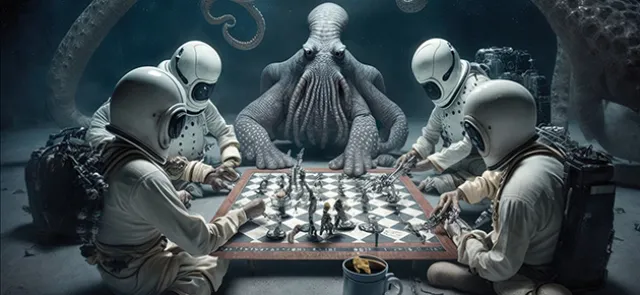
Wittgenstein's iconoclastic philosophy of mathematics
The relationship between language and reality lies at the heart of Wittgenstein's thought. The issue takes on its full significance when it comes to mathematical entities. What if philosophers speculating about the rigorous logical foundations of these abstractions were on the wrong track?
The golden ratio: mathematical properties
An evocative subtitle, "La proportion magique" (The magic proportion), a foreword by Cédric Villani, a preface by Étienne Ghys, a glossy cover, high-quality paper, meticulous geometric drawings and understated but well-chosen illustrations: everything about this book invites you to open it.
The Game of Life: An English-language bible
The many devotees of the Game of Life, devised by John Conway in 1970, now have their bible.