By observing the motions of the heavens, the Pythagoreans conceived of the world as spherical, with the Earth at its center—the most perfect of forms. Before long, the Earth itself was seen as a sphere and became the touchstone of mathematical inquiry, since Greek mathematicians were all "geometers"—that is, measurers of the Earth. Thereafter, Greek geometers never ceased trying to measure the properties of what they observed: length, area and volume.
Getting to grips with surfaces
---------------------
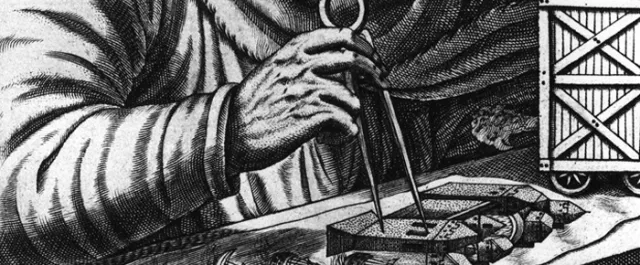
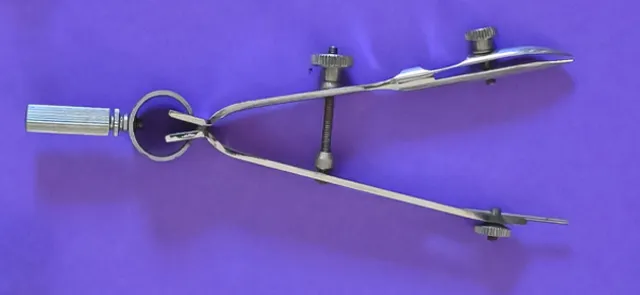
To compare two surfaces, the Greeks constructed a square of equal area for each figure, using straightedge and compass. Comparing the squares then made it easy to compare the surfaces. But some shapes, including the circle, resisted quadrature. The lunes of Hippocrates of Chios made one particular quadrature possible and long encouraged the mistaken belief that the famous squaring of the circle was possible (see The Circle, Bibliothèque Tangente 36, 2009).
Greek geometers naturally took an interest in the surface areas and volumes of solids, and Eudoxus of Cnidus produced the first results—and, above all, a method. Using ingenious dissections (see the feature "Ingenious calculations of perimeters, areas and volumes", Tangente 154, 2013), he estimated the quantity sought and then proved geometrically that the result could be neither greater nor smaller; it therefore had to equal that estimate. In this way, he calculated the surface areas and volumes of cylinders and cones, as recorded in Euclid's Éléments (The Elements). This two-pronged proof by contradiction, also known as apagogic reasoning, is called the method of exhaustion. But for even moderately complicated volumes, this ingenious method requires genuine geometric talent and is difficult to generalize.
The preeminent figure in ancient integration was Archimedes (287–212 BCE). He established the circumference of a circle, enabling him to give precise bounds for π. He was the first to show that π appears in the area of a disk, proving, by the equivalent of "taking a limit", that the disk's area equals that of a triangle whose base is the circle's circumference and whose height is its radius.