Archimedes may well have been the greatest genius of Greek mathematics (see Tangente 150, 2013). He lived in the 3rd century BCE and spent most of his life in his native Syracuse, perhaps making a few journeys to Alexandria and corresponding with the mathematicians of his day to inform the scholarly community of his discoveries. He is remembered for the cry "Eureka!" and the words "Give me a place to stand, and I shall move the world"; yet neither quotation appears in his writings, and both were reported by much later authors—Plutarch and Pappus, respectively. Many of his original works have survived, however, and in them Archimedes displays the full extent of his genius: approximating π and establishing bounds for it, investigating commensurability through a puzzle (the Stomachion), exploring variations on the arbelos, the quadrature of the parabola, and determining the ratio between the volumes of a sphere and a cylinder. He was proudest of this last result—so proud that he asked for a sphere and a cylinder to be depicted on his tomb. This enabled Cicero to identify it after the people of Syracuse had forgotten it. One result that perhaps best exemplifies Archimedes' distinctive genius is the quadrature of the spiral: determining the area swept out by a spiral during its first revolution.
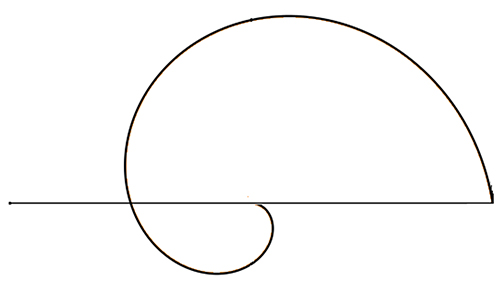
A spiral—but which one?
----------------------------
The spiral is a mathematical curve invented by Archimedes: many people had drawn spirals in the sand or on the walls of prehistoric caves, but no one had given them a mathematical definition. In On Spirals, Archimedes offers a kinematic construction: "If a straight line, one of whose ends remains fixed, rotates uniformly in a plane until it returns to its initial position, and if a point on the rotating line moves uniformly away from the fixed point, that point will describe a spiral in the plane." This "practical" definition captures the physical intuition of the Greek mathematicians, who began devising non-circular curves traced by ingenious mechanisms, such as the quadratrix and the conchoid (see the feature "Construction mécanique des courbes" in Tangente 151, 2013).
This definition is more than a convenient way of describing a curve: it directly yields a very interesting result concerning the "radii" that can be drawn. Proposition 12 of On Spirals states: "If any number of straight lines [segments] are drawn from the origin of a spiral described in any single revolution, making equal angles with one another, these lines exceed one another by the same amount." Put simply, radii drawn at constant angular intervals form an arithmetic progression. This follows from the very definition of the spiral, which specifies uniform motion (see box).