This is not a square
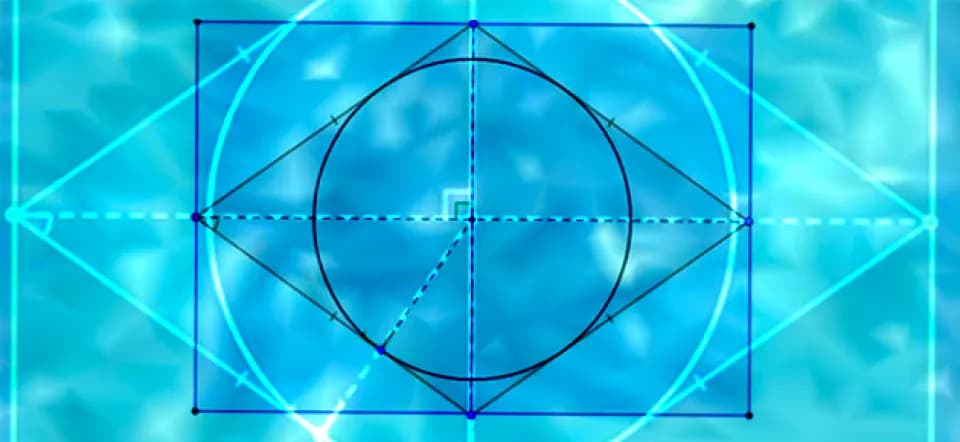
A square is a special kind of rhombus. Anyone can easily calculate the area of a square, but what about the area of a rhombus? Similarly, a square has both a circumcircle and an incircle. What happens in the case of a rhombus?


A square is a special kind of rhombus. Anyone can easily calculate the area of a square, but what about the area of a rhombus? Similarly, a square has both a circumcircle and an incircle. What happens in the case of a rhombus?


Articles recommended for you.

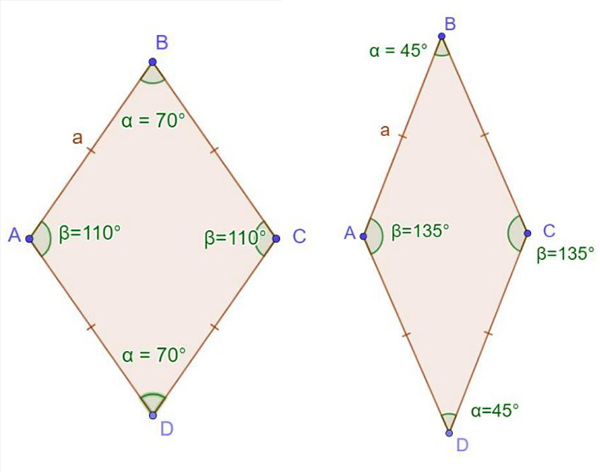
For many people, the rhombus—originally called a "rhomb" (see In Brief, "The origin of the rhombus"; the associated adjective is still "rhombic")—is characterized by its acute angles pointing upward and downward. Yet, as Euclid already observed, this quadrilateral is defined by the equal lengths of its sides. Its ability to form tilings accounts for its use in architecture and decoration.

Three sides completely determine a triangle, up to orientation. With four sides, infinitely many polygons can be constructed. Nevertheless, many general properties can be established for arbitrary convex quadrilaterals.

While the formula for the area of an arbitrary triangle has been known for a long time, that of an arbitrary quadrilateral took longer to emerge. Yet the two formulas share a kinship — visual, if nothing else — that is quite fascinating.

The discovery that so simple a figure as a square cannot have both sides and diagonals of integer length troubled several great scholars of antiquity. Can polygons with this property nevertheless be found? This seemingly innocent question continues to open up new avenues of research today.
Discussion
Sign in to post a comment and talk with other readers.
No comments yet. Be the first to respond.