The rectangle's dual
--------------------
Here are some properties of a rhombus:
1\. all its sides are equal in length;
2\. opposite angles are equal;
3\. the diagonals meet at equal angles;
4\. it is a parallelogram with two adjacent sides of equal length;
5\. its axes of symmetry bisect opposite angles;
6\. it has an inscribed circle whose center is equidistant from the sides.
Now compare these with some properties of a rectangle:
1\. all its angles are equal;
2\. opposite sides are equal in length;
3\. the diagonals are equal in length;
4\. it is a parallelogram with two adjacent equal angles;
5\. its axes of symmetry bisect opposite sides;
6\. it has a circumcircle whose center is equidistant from the vertices.
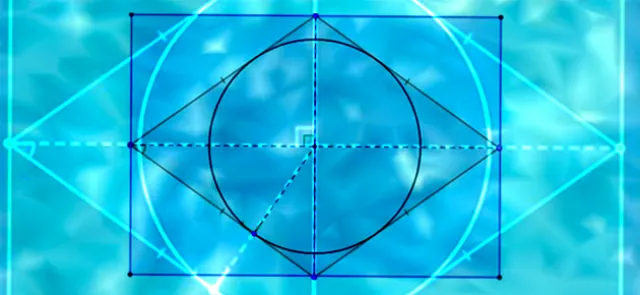
In the list of properties of a rhombus, replace the words "side" and "length" with "angle" and "measure", and vice versa: you obtain the properties of a rectangle, apart from the last one, which is slightly more subtle. Because of this analogy, the rhombus is said to be the dual of the rectangle (the square is its own dual). This duality, which can be defined for quadrilaterals, holds in Euclidean geometry.
This duality should not be confused with the duality between points and lines found in projective geometry (see Tangente 189, 2019), illustrated by the statements: "Through any two distinct points there passes exactly one line" and "Two distinct lines intersect at exactly one point."
In Penrose tilings
---------------------------
A search for tilings made from rhombi immediately turns up periodic patterns (like any quadrilateral, a rhombus can tile the plane). There are also Penrose tilings (see Tangente 198, 2021), notably the P3 type. These tilings are constructed from two particular rhombuses related to the golden ratio: a "thin" one whose smallest angle is 36°, and a "thick" one whose smallest angle is 72°.
####
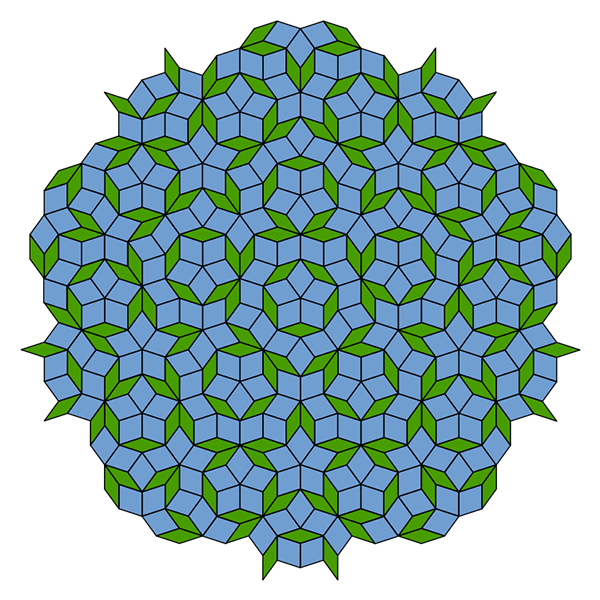
A P3 Penrose tiling.
In fact, there are infinitely many such tilings. They were discovered in the 1970s by the British mathematician and physicist Roger Penrose, born in 1931 and awarded the 2020 Nobel Prize in Physics (see our feature in Tangente 198). These tilings are all non-periodic: there is no translation that leaves them invariant.
Beyond their artistic appeal, these tilings serve as models for quasicrystals: solids that behave like conventional crystals but whose structure is not periodic. The discovery, made in 1982, earned its discoverer, the Israeli scientist Dan Shechtman, born in 1941, the 2011 Nobel Prize in Chemistry.
Hex: hexagons on a rhombus
----------------------------------
The game of Hex was created in 1942 by the Danish physicist Piet Hein (1905–1996) under the name Polygone. It was then independently reinvented in 1948 by the American mathematician John Nash (1928–2015), who brought it to the attention of the scientific community. Since 2011, the game has been published by the International Committee for Mathematical Games (CIJM).
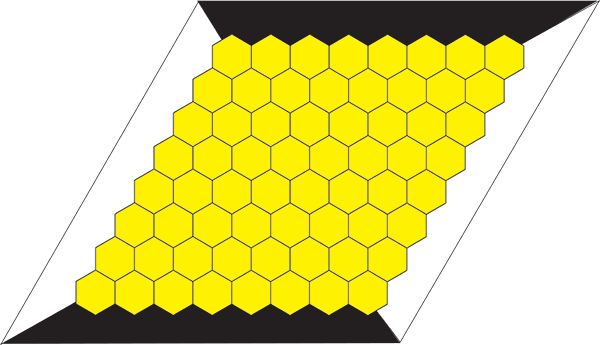
The Hex board.
The two players, White and Black, take turns placing their pieces on an 8 × 8 rhombus-shaped board whose cells form a hexagonal lattice: every cell not on the edge of the board has six neighbors with which it shares a side. Pieces are neither captured nor moved. The first player to connect the two edges marked with their color by an unbroken chain of their own pieces wins the game. One distinctive feature of Hex is that a game can never end in a draw.
Discover Hex and dozens of other games in Mathématiques et Jeux de société (Mathematics and Board Games), Bibliothèque Tangente 83, 2023!