



A sharp topic: the rhombus
Forgotten quadrilateral, little-known parallelogram, the rhombus is a figure almost ignored by geometry: its mathematical properties seem rather meager. Yet it retains a share of mystery, which this feature will help you unravel. First of all, the origin of the word "rhombus" remains enigmatic. Then, one may wonder whether every rhombus has an incircle, or is circumscribed by a circle (think about it for a moment, these are not such obvious questions!). Or whether one can construct polyhedra whose faces are rhombuses. Finally, just as there are "magic squares", there has recently existed a "magic rhombus"!
All articles in this folder
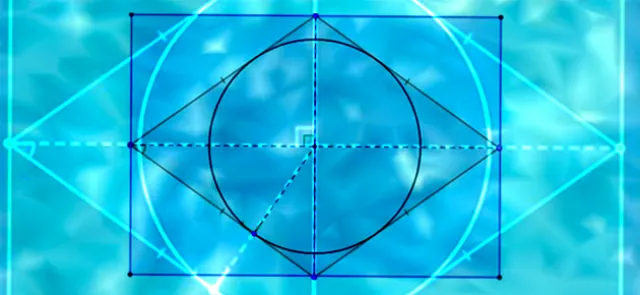
This is not a square
A square is a special kind of rhombus. Anyone can easily calculate the area of a square, but what about the area of a rhombus? Similarly, a square has both a circumcircle and an incircle. What happens in the case of a rhombus?

Rhombus Notes – A Mathematical Brief | Tangente
Did you know?
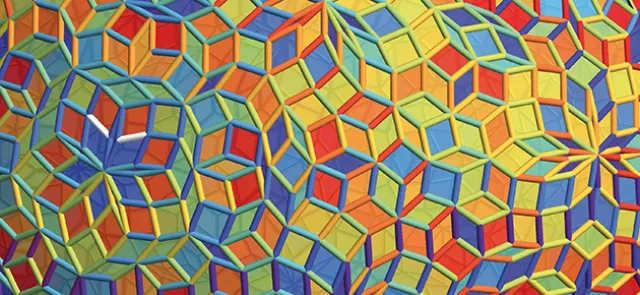
Rhombi filling space – Article | Tangente
Are there polyhedra whose faces are all rhombi? Various mathematicians have studied this problem in solid geometry since the 17th century, each contributing to what is now a complete classification of the convex polyhedra.

A magic rhombus – mathematics brief | Tangente
In August 2019, our reader Mustapha Rherrad created a magic rhombus using the integers from 1 to 32, arranged so that the sums along every "slanting row" and every "main diagonal" are equal.

On the road – Mathematical brief | Tangente
Both unusual—since it does not usually rest on its "base"—and harmonious, as it is a quadrilateral with four equal sides, the rhombus appeals to graphic artists, advertisers and other designers: it appears in puzzles, games, road signs, logos…

The origin of the rhombus – Maths brief | Tangente
Many mathematical terms have Greek or Latin roots. But the word "losange", the French for rhombus, is something of a puzzle: its origin is disputed.

From rhomb to rhombus
For many people, the rhombus—originally called a "rhomb" (see In Brief, "The origin of the rhombus"; the associated adjective is still "rhombic")—is characterized by its acute angles pointing upward and downward. Yet, as Euclid already observed, this quadrilateral is defined by the equal lengths of its sides. Its ability to form tilings accounts for its use in architecture and decoration.