



The sphere
The sphere is one of the most elementary objects in geometry. To study it, since Archimedes, treasures of ingenuity have been deployed. The most famous of them is the one we inhabit, but it took centuries to become convinced that the Earth is 'round'! And the multiple attempts at cartographic representations have given rise to mathematical developments that have sometimes held quite a few surprises. Each projection of the globe onto the plane generates its share of deformations, transformations of areas, modifications of properties. Thus, the stereographic projection preserves angles, but not distances. How to choose 'the' right way to visualize this object? Depending on the characteristics to be preserved, various types of transformations have been devised. And if we took the time to revisit the properties of the sphere?
All articles in this folder
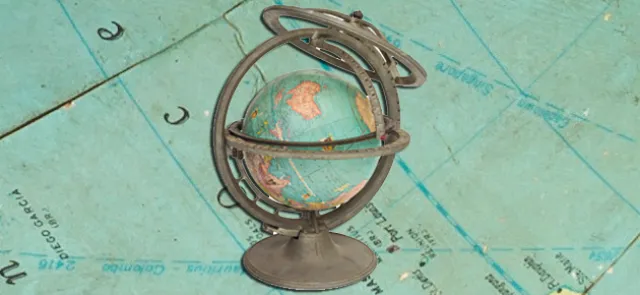
Mapping and the geometry of the Earth | Tangente
Understanding the shape of the planet we live on, and then depicting it, has been an adventure since the earliest days of antiquity. At every stage, the model has been refined and improved, drawing ever closer to the one we use today: the geoid.
The sphere effect
The sphere came to be seen as a model of the world because of its perfection. Greek mathematicians soon sought to measure its properties, laying the groundwork for calculation techniques that would not bear fruit until centuries later.

Art and the sphere: when mathematics inspires | Tangente
A brief look at several artists who have made the sphere their subject.
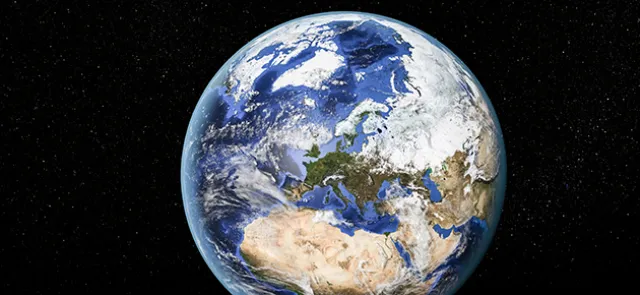
Stereographic projection
Since 2021, the Bourse de commerce in Paris has been open to the public, showcasing contemporary art from the Pinault Collection. Its superbly renovated interior offers mathematicians an opportunity to explore… stereographic projections!