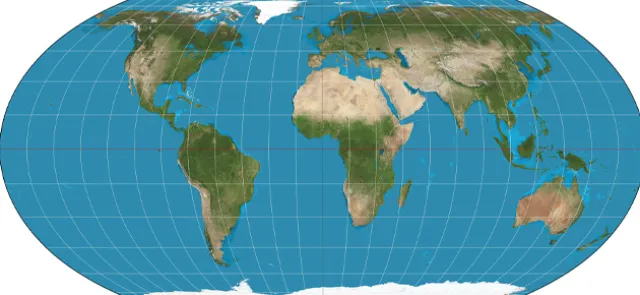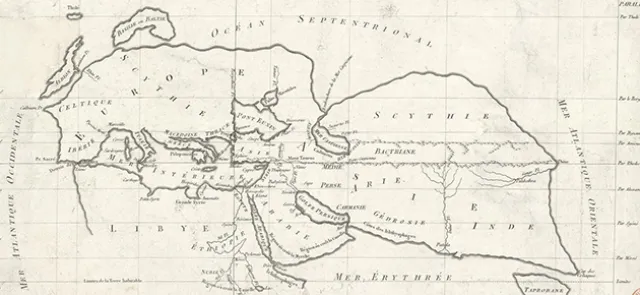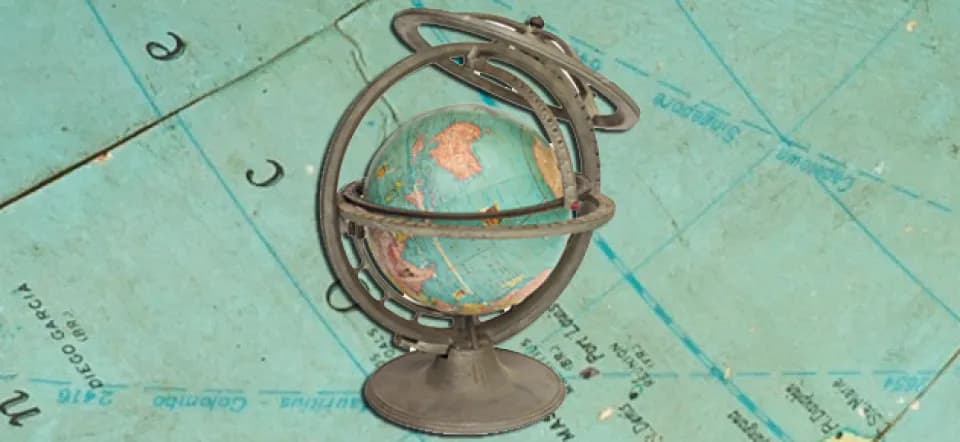
As early as the 6th century BCE, philosophers and mathematicians were asking about the shape of the Earth. Their answers evolved over the centuries and, aided by advances in geometrical techniques, gave rise to different representations of our planet.
The earliest imagined shapes
--------------------------------
Ancient civilizations (Egypt, Babylon, Persia, archaic Greece, India and China) imagined the Earth in various forms: flat—rectangular or square, and sometimes circular—it floated on water beneath a hemispherical sky. In the 5th century BCE, a new conception of our planet's shape emerged, based on astronomical observations and geometry.
The Greek mathematician Thales (c. 625–c. 546 BCE) imagined the Earth as a disk floating on a body of water, with the universe forming a bubble of air above it all. Around the same time, Anaximander of Miletus (c. 610–c. 546 BCE) challenged this theory: no, the Earth was not flat, but resembled a cylinder floating in space, whose upper face, surrounded by water, was our habitable world. A century later, Pythagoras—famous for more than just “his” celebrated theorem—was the first to assert that the Earth was spherical. His student Parmenides agreed and passed on the theory. Another century later, the philosopher Aristotle (384–322 BCE), observing lunar eclipses, believed he could prove that the Earth really was spherical. Then came Eratosthenes (c. 273–c. 192 BCE), who, since the Earth was a sphere, devised an ingenious method for calculating its radius.