Which way should we face when we pray ? In the Muslim tradition, worshippers should face Mecca. Doing so accurately requires solving a delicate problem in spherical trigonometry—one that also yields interesting ideas for drawing maps of the Earth.
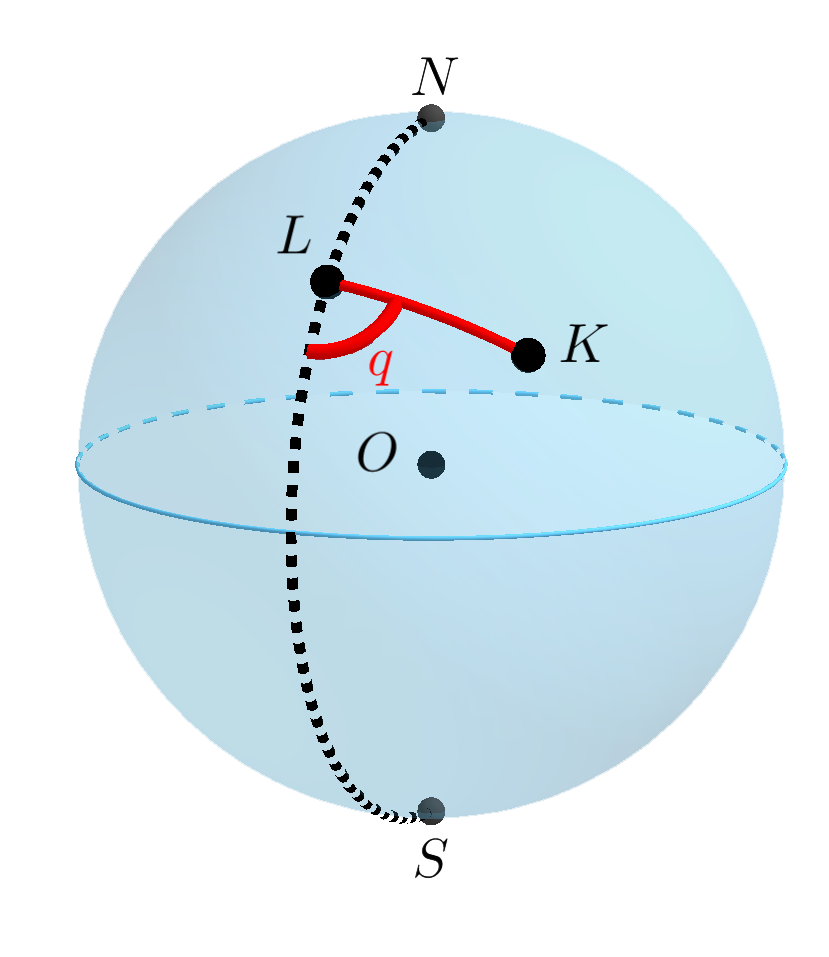
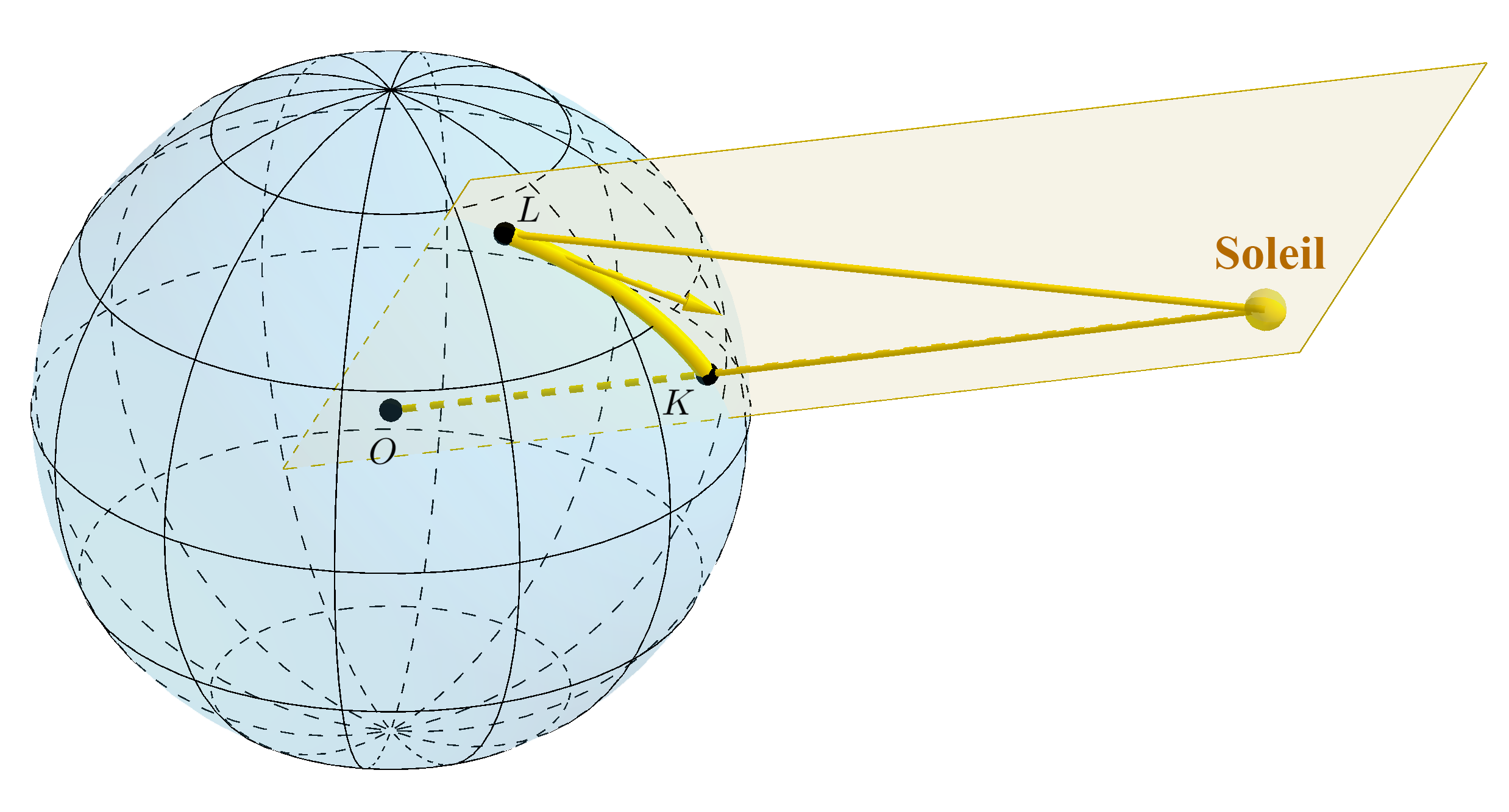
Because the Earth is round, among other reasons, aligning a mosque or prayer rug precisely toward Mecca is no simple matter. By definition, the qibla ("direction") at a given location on the Earth's surface is the angle from due south at which one must face to look precisely toward the holy city—or, more exactly, toward its iconic sacred monument, the Kaaba. In more mathematical terms, we must find the angle between the meridian through and the route from to the Kaaba . This arc lies on the great circle through and (see box below). Knowing the angle allows worshippers to follow the instruction given in the Qur'an, surah 2, verse 144: "So turn your face toward the Sacred Mosque. Wherever you may be, turn your faces toward it." One foolproof way to determine the qibla anywhere with minimal effort is to make use of the fact that the Kaaba lies between the tropics, in the region around the equator comprising the points where, twice a year, the Sun passes directly overhead (at the zenith). At the Kaaba, this occurs on May 27 (or May 28, depending on the year) and July 15 (or July 16). On those days, when the Sun reaches its highest point—that is, at solar noon—a perfectly upright stick planted in the ground in Mecca casts no shadow. At that instant, anywhere else in the world, looking toward the Sun is exactly equivalent to facing the Kaaba.