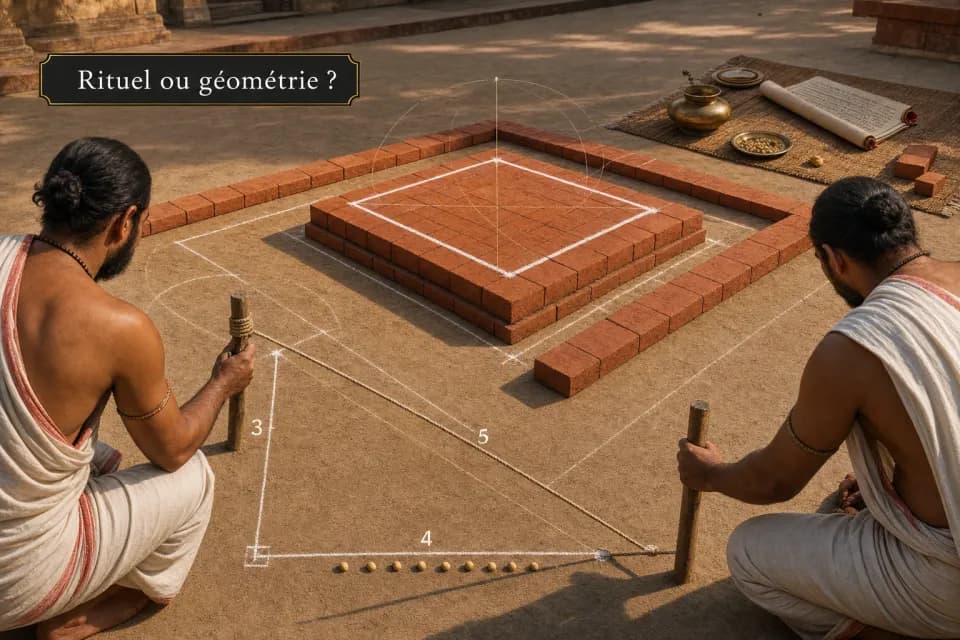
Appearing in South Asia nearly three thousand years ago, the earliest mathematical texts in Sanskrit set down certain elements of ritual. They allow us to better understand how religious ceremonies were bound up with questions of arithmetic, geometry, and even the study of algorithms. In recent years, these questions have also taken on an ideological dimension.
The Vedas (literally "knowledge") are oral religious poems from South Asia, a region encompassing present-day Pakistan and India, as well as Ceylon, Nepal, Bhutan, and parts of Afghanistan. These poems gave rise to scholarly texts commenting on their language, the nature of their verses, their etymology, the auspicious time for performing a ritual, and so on. Although such religious poems may seem far removed from mathematics, some of the texts commenting on them set out to list numbers and pay them homage. Thus, an important Vedic ritual text, the Collection of Tittiri's Followers (Taittirīyasamhitā, perhaps written in the 6 century BCE), provides mantras to be recited during a rite in which food is offered to the gods — a rite forming part of the famous horse sacrifice (TS.7.2.11-20). The mantras honour numbers presented in lists. They honour all the odd numbers from one to ninety-nine, all the even numbers from two to one hundred, and all multiples of four, five, twenty, or fifty up to one hundred or one thousand. These lists thus form part of the history of number sequences and series.