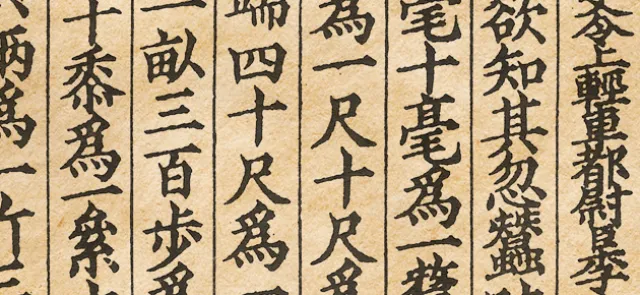
The development, and subsequent adoption by other communities, of scientific and technical achievements took place over the long term under different conditions in East Asia and, broadly speaking, around the Mediterranean Basin. For example, in what, seen from China, is indiscriminately the "West," the continuation of scientific activity repeatedly required transcriptions and translations (from Akkadian and Demotic into Greek, from Greek into Syriac, from Greek into Arabic, from Sanskrit into Arabic, from Arabic into Latin, from Hebrew into Latin, from Greek into Latin…). In East Asia, however, the situation was quite different: despite the linguistic differences affecting oral communication among Chinese speakers from north to south and east to west, they share a common writing system and can therefore read one another; likewise, Korea and Japan adopted Chinese characters to write their own languages, even though these languages are quite far removed from Chinese. The consequences were crucial for the practice of science: aside from the technical challenges of their development, scientific texts written in Chinese could be taken up without mediation across the Middle Kingdom for centuries on end, or circulate from China to Korea (see the article "Tradition and algebraic innovation in Korea") or to Japan (see the article "Wasan, or the mathematics of the Edo period"), where they fueled a great deal of scientific activity. In this sense, China played something of a role in East Asia befitting the name it gives itself: the "Middle Kingdom," and the history of science in China is essential reading for anyone wishing to work on the sciences of this region of the world.
The Nine Chapters, at the heart of the mathematical tradition
------------------------------------------------------------
The earliest available mathematical documents (see the article "Sources and the variety of so-called Chinese mathematics") date from the beginnings of the Chinese Empire, whose first phase of political unification took place between the third century BCE and the third century CE. It was during this period that the essential institutions of the Empire were put in place, including in the sphere of knowledge: archives were organized, bibliographies were drawn up, and data—astronomical data, for instance—were collected during measurement campaigns and put in order. This was also the time when the classics, such as the Confucian texts in philosophy, were defined as such, and when work was undertaken to establish their text. The same holds for mathematics: probably in the first century, the work that was to become, in a sense, the classic of the discipline was completed: The Nine Chapters on Mathematical Procedures (see the article "The Nine Chapters, a foundational work"), whose title will hereafter be abbreviated to The Nine Chapters. The editorial work that produced this text continued over centuries, beginning, according to the earliest available testimony, in the second century BCE, and drawing on fragments of ancient texts. We are still unable to describe the genesis of this synthesis of earlier mathematical knowledge. However, since the 1980s, archaeology has been bringing to light mathematical manuscripts from the early Empire and gradually providing elements of an answer to this question. Many later mathematicians, up to the 17th century, would refer to this work, work on it, and take it as both a source and a model.
The mathematical knowledge found in it is partly linked to the needs of the bureaucracy: problems of calculating and apportioning taxes, organizing public works, and so on. The work also addresses many other mathematical topics. In particular, The Nine Chapters contains the full set of rules for fractional arithmetic, the rule of three, procedures for unequal sharing, algorithms for extracting square and cube roots as well as for solving certain quadratic equations, formulas for computing areas and volumes, the rule of double false position (which makes it possible to solve, even if only approximately, any problem of arithmetic or elementary algebra), algorithms for solving systems of simultaneous linear equations, and numerous problems making use of what is customarily called "the Pythagorean theorem." In short, this is one of the most important mathematical books to have been published at the start of the common era. In the following centuries, many commentaries would be written on it, showing an explicit interest in proofs of the correctness of the classic's algorithms. Some of these commentaries were selected to be transmitted alongside the classic itself, so that, as with the classics of other disciplines, every edition of the work today comes with the commentaries retained by tradition.