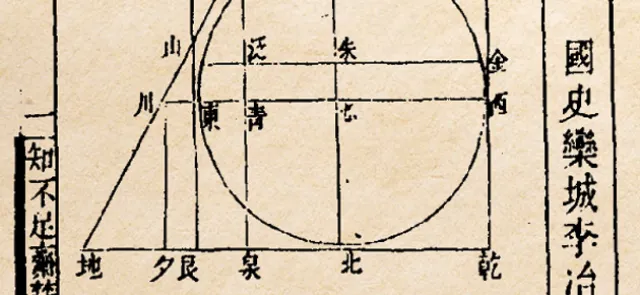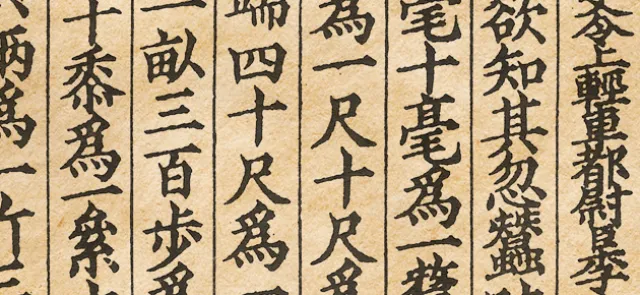
Translating a Chinese-language mathematical treatise into French—or any other language—is no easy task. So much so that even a title can be translated in different ways, reflecting different interpretations and sensibilities. For example, Li Ye's Ceyuan haijing (1248) is translated as The sea mirror of circle measurements by Charlotte Pollet, but as The mirror of the sea of circle measurement by Célestin Xiaohan Zhou. While that difference may seem slight, it is rather more pronounced for Zhu Shijie's Siyuan Yujian (1303), which Pollet translates as The precious mirror of the four unknowns and Zhou as The jade mirror of the four elements . Similarly, Jiuzhang Suanshu is often referred to as The nine chapters on the mathematical art, a title Karine Chemla translates as The nine chapters on mathematical procedures .
These translations involve choices that can foreground a particular reading, understanding or interpretation of a text. Typically, Karine Chemla's translation emphasizes a rigorous theoretical abstraction that the idea of "art" in the commonly cited translation fails to convey. Some treatises will therefore appear under two different translated titles in the pages that follow, since standardizing them would have meant betraying one author's thinking in favor of another's. This also reflects the richness of scholarship on the history of mathematics in China.
Japan and Korea
----------------
For Japanese, we will use the standard system of romanization developed by the American James Curtis Hepburn in the late 19th century.
Finally, for Korean, we will give a transcription in Latin characters alongside the two scripts used locally: first, hangeul, a Korean script invented as early as the 15th century but used only since the late 19th century; and second, hanja, which uses Chinese characters whose pronunciation differs between Korean and Chinese, as is still invariably done for historical names.
Simple transcriptions
----------------------------
Mandarin Chinese is difficult to transcribe in Latin characters because it has a feature unfamiliar to us: tones. A vowel may be pronounced with a rising tone, a falling tone, a tone that falls slightly before rising again, a neutral tone, and so on. Thus, what we might transcribe as ma could in fact be mā (mother), má (hemp), m (horse), mà (to scold), or ma (an interrogative particle). Pinyin transcription, with its diacritics, captures this variety of pronunciations.
Nevertheless, for this issue we chose to simplify the transcription by omitting the diacritics to make the text easier to read, since pronouncing the tones correctly takes practice. For example, the mathematician Yáng Huī's name will simply be written Yang Hui.