This issue is not fully translated into English yet; only translated content is shown.
Read the French versionAll folders in this issue



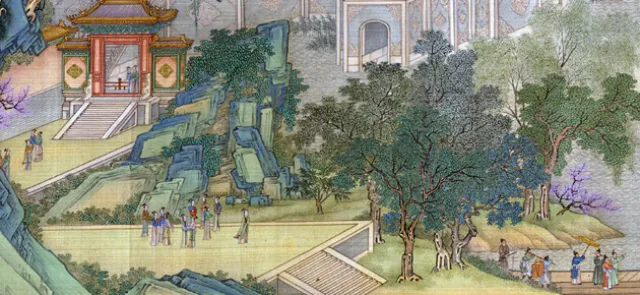
The foundational texts
China represents the center of East Asian mathematics because its continued geopolitical power and its script used by other civilizations enabled all mathematical corpus written in Chinese to be read, adapted and deepened over the centuries. The texts that have come down to us are nevertheless not very numerous and are the consequence of the choices of successive dynasties. If the most famous – and oldest – treatise is The Nine Chapters, many other works have developed very advanced, original research and sometimes ahead of what was being done in Europe at the same time. Nevertheless, the so-called Chinese mathematics do not present themselves as a unity: that is where things become interesting!
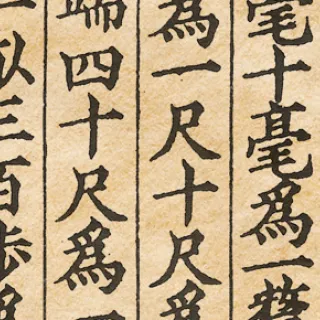
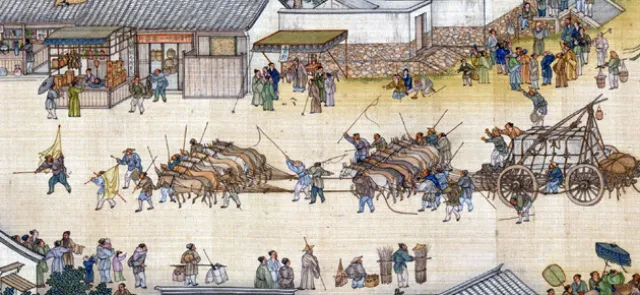
The practice of mathematics in China
Taking an interest in other cultures implies stepping out of the natural Eurocentrism that is ours. From then on, questioning the existence of "our" proof, derived from Euclid, in East Asian mathematics becomes obsolete. It is, however, instructive to follow the importation and dissemination of this concept. The study of the impact of this event thus makes it possible to understand the distance between different practices of mathematics. How do we set up an equation? How do we calculate? The methods are numerous and their discovery proves fruitful, including for those that the mathematical tradition in China may have forgotten from its own past.


Rising Sun and Calm Morning: Japan and Korea
China is far from being the only East Asian civilization to have achieved a high degree of mathematical depth. Japan and Korea drew from it to develop their own knowledge and practices. In Japan, the wasan of the Edo period is far from a pale copy of Chinese models: among other things, it features the intriguing practice of sangaku, which blends geometry, art and spirituality. Subsequently, the yōsan of the Meiji era notably addressed questions of method as well as linguistics in order to absorb English-language mathematics. As for Korea, it had mastered algebraic elimination methods far ahead of those in Europe, resulting in particular in magic squares that Euler rediscovered much later.