



Rising Sun and Calm Morning: Japan and Korea
China is far from being the only East Asian civilization to have achieved a high degree of mathematical depth. Japan and Korea drew from it to develop their own knowledge and practices. In Japan, the wasan of the Edo period is far from a pale copy of Chinese models: among other things, it features the intriguing practice of sangaku, which blends geometry, art and spirituality. Subsequently, the yōsan of the Meiji era notably addressed questions of method as well as linguistics in order to absorb English-language mathematics. As for Korea, it had mastered algebraic elimination methods far ahead of those in Europe, resulting in particular in magic squares that Euler rediscovered much later.
All articles in this folder
 Podcast
Wasan: Japanese mathematics of the Edo period | Tangente
Rooted in the tradition of Chinese-language treatises, the Japanese mathematics of the Edo period (wasan) is far from a pale copy: the problems and methods developed at the time display remarkable originality in the history of mathematics.
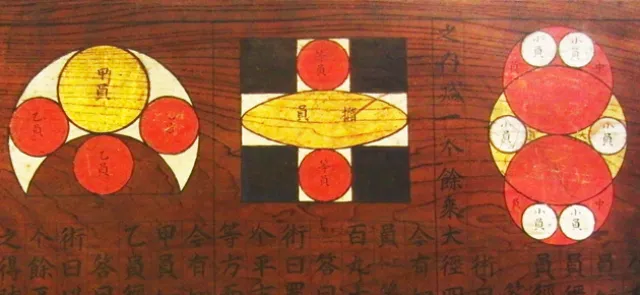
Sangaku: geometry in Japan's temples | Tangente
Sangaku are a remarkable practice, bringing together mathematics, art and spirituality. They offer a precious glimpse into the mathematics practiced during the Edo period and give a sense of how sophisticated popular mathematical culture was at the time.
 Podcast
Wasan to yōsan: Japan's Meiji math revolution | Tangente
The opening of Japan during the Meiji era brought changes in the way mathematics was done and written. Questions of method, but also of language, arose. Kikuchi Dairoku, the future Minister of Education of Japan, overhauled mathematics textbooks accordingly.
 Podcast
Algebraic tradition and innovation in Korea | Tangente
The tradition of examinations helped develop a culture blending tradition and innovation in 18th-century Korea. Thus, a Euler square was created even before Euler took an interest in the subject, while the Chinese method corresponding to Gauss-Jordan elimination was widely mastered.