The first thing that strikes anyone approaching the mathematical texts of the ancient Chinese-speaking worlds is that there ought to be more of them. How could such a rich world have left so few mathematical texts? The way these documents have reached us is in fact significant, and tells us something about the nature of the activity we call "mathematics" and how it is divided into disciplines. This raises the question of the neutrality of the transmission of knowledge. The history of China offers a fine argument on this point.
Ancient texts, recent editions
-----------------------------------
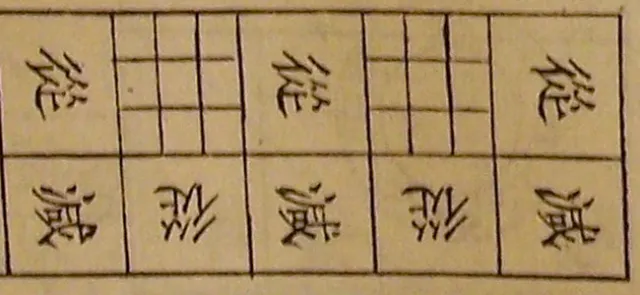
The oldest documents we have are texts recovered through archaeological research: engraved stone or tortoise shell, or bamboo strips marked with multiplication tables. But when it comes to ancient Chinese documents that could be described as more fully "written," we have around ten texts whose content dates from the Han (between the 3rd century BC and the 3rd century AD) but whose oldest surviving editions date from the Song (960–1279) or the Yuan (1271–1368). These are texts composed under the Han, sometimes with commentaries, which were later used in examination contexts under the Sui (581–618) and Tang (618–907). Some texts are compilations, such as The Mathematical Classic of Master Sun (Sunzi Suanjing), which was used as a textbook between 581 and 907 but was partly composed between 280 and 473, and whose oldest surviving edition dates from the 13th century. Several layers of composition can be distinguished in it, along with units of measurement from different periods or contexts. This work is included among the Ten Canons of Mathematics (see box).
It is difficult to know how mathematical knowledge was transmitted before the Sui dynasty (581–618), which set up, for the first time, a system of mathematical education at the government level. Several channels of transmission can be surmised: study under a master, family, self-teaching, or religious networks…
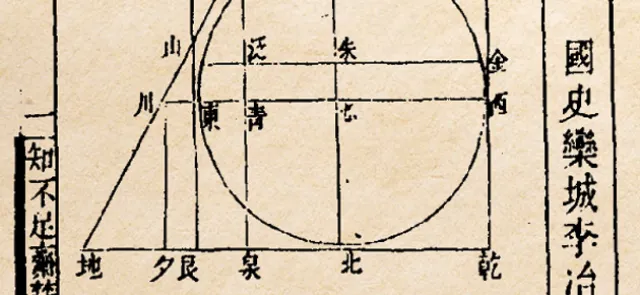
It turns out that none of these texts is accompanied by the geometric figures they nonetheless discuss — so much so that some have gone as far as wrongly claiming that geometry did not exist in China. Nor do we possess the originals, since the available editions date from the Song. There are also a dozen or so texts composed, this time, under the Song and the Yuan (12th - 14th century), whose available editions date from the Qing (1644–1912). These latter texts do not come from schools or administrative circles, but attest to high-level investigative work without revealing much about the context of their production. This shows that the absence of documentation is by no means proof of the absence of scholarly activity, and that the available texts are only the tip of the iceberg of mathematical activity.