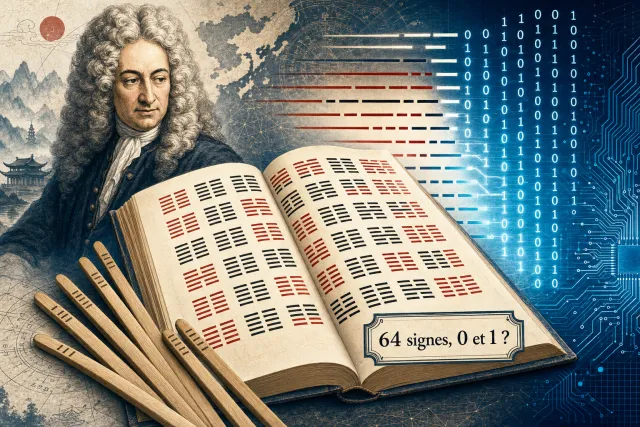

The Book of Changes (Yi Jing) originated in divination practices involving the drawing of yarrow stalks (long rods) associated with the Zhou dynasty (1st millennium BC). Suppose we want to form a symbol made up of three lines—a trigram—with each line either broken or solid. This gives eight possible trigrams:

Yet the text itself deals with hexagrams, symbols formed from two trigrams. There are naturally 82 = 64 possibilities. The Yi Jing is organized into 64 sections, each devoted to a hexagram (gua) and a collection of sayings. Solid lines are associated with yang,

and with the odd numbers 9 and 7; broken lines are associated with yin, 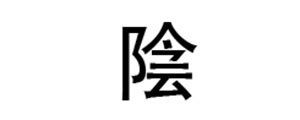 and with the even numbers 8 and 6. Each hexagram has a name referring to an object (well, cauldron), a situation, a state or an action (waiting, marriage proposal, encounter), a quality (modesty, elegance), an emotion (joy, dejection), or a relationship (family/clan, solidarity, conflict).