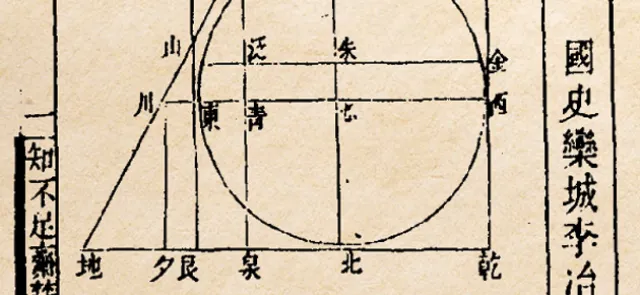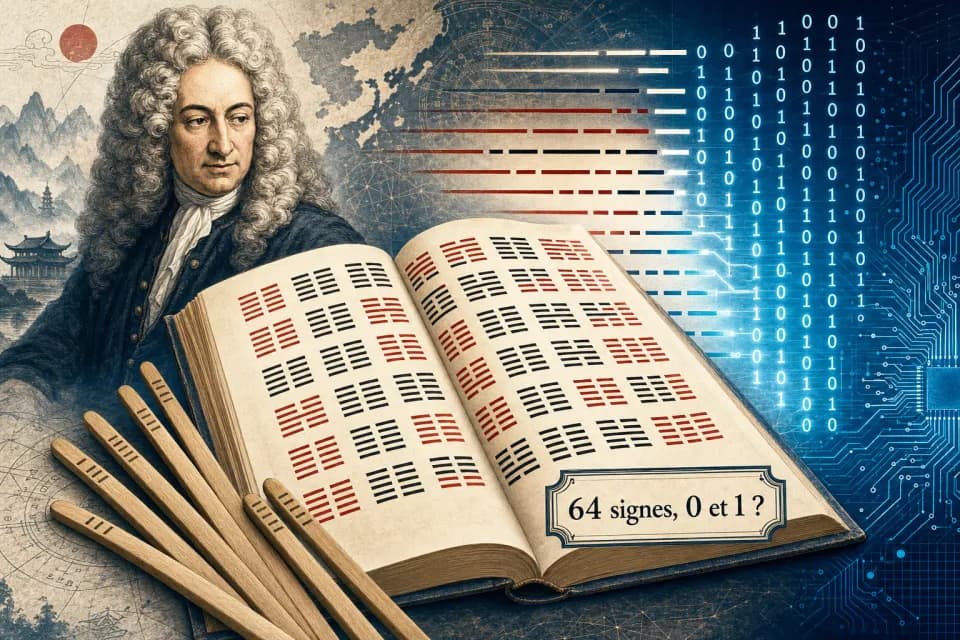
The history of mathematics is punctuated by surprising encounters, but few are as unlikely as that between Leibniz and ancient China's Book of Changes. When the philosopher discovered the hexagrams it contained, he saw—or rather believed he saw—a forerunner of his own binary system, as well as evidence that human knowledge is universal.
A mathematician and philosopher, Leibniz was a thinker in pursuit of comprehensive knowledge, the mathesis universalis. For him, mathematics was not merely the science of quantity, but the laboratory of a universal logic (see the article "Something Rather than Nothing"). If we embrace this idea of universality, we should expect to find truths shared by every civilization. From the end of the 16 century onward, Jesuit missionaries began introducing China to Europeans. Many Chinese works, starting with the great classics, were translated into Latin and made available, notably the Book of Changes (易經, Yi Jing). Its origins lie in divination practices involving the drawing of yarrow stalks (long sticks), associated with the Zhou dynasty (1 millennium BC). It consists of two parts: the older presents 64 short sections or paragraphs, each headed by a hexagram (see box), while the more recent part comprises commentaries, glosses and essays. The earliest Western translations drew on the commentaries and interpretations of some influential Song-dynasty scholars (960–1279), particularly Cheng Yi (1033–1107) and Zhu Xi (1130–1200).