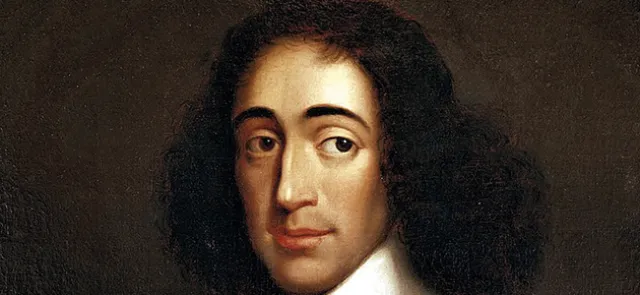
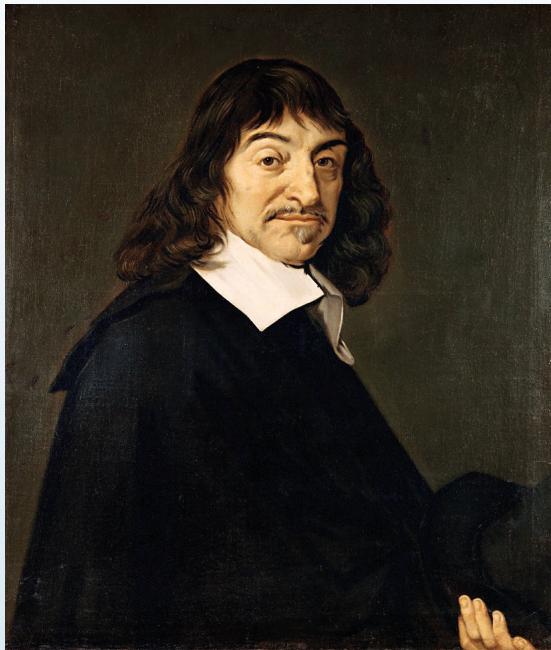
Today, the adjective "Cartesian" describes someone as rational—perhaps even as a rationalist—and hence as an unbeliever. Yet Descartes's tomb in the church of Saint-Germain-des-Prés in Paris bears the title reconditor fidei, restorer of the faith. In fact, the philosophy of the celebrated author of cogito ergo sum was the very opposite of atheism.
René Descartes (1596–1650) is known as the author of the famous phrase "I think, therefore I am." At high school, we may also have learned that he invented what are now called Cartesian coordinate systems and, in doing so, analytic geometry. Finally, we know that in physics he formulated laws governing the reflection and refraction of light. Today, however, Descartes's scientific work has largely been either absorbed into later science or superseded, so that its connection with his philosophy is no longer apparent. To establish the reliability of his results in physics, Descartes relied on three certainties: his own existence as a being capable of thought, the existence of an almighty creator God who does not deceive, and the logical soundness of mathematics.
Why did he need to put his findings on a firm foundation? Today, the experimental method, in which experiment and theory—often expressed in mathematical language—inform each other, is universally accepted. In Descartes's time, however, this approach was largely new. He was one of its pioneers and needed to be sure that the method was valid. To understand why—
Why did he need to put his findings on a firm foundation? Today, the experimental method, in which experiment and theory—often expressed in mathematical language—inform each other, is universally accepted. In Descartes's time, however, this approach was largely new. He was one of its pioneers and needed to be sure that the method was valid. To understand why, we need to follow his intellectual journey, as he recounts it in the first part of his celebrated Discourse on the Method (1637): "From childhood, I had been steeped in the study of letters, for I had been persuaded that through them one could acquire clear and certain knowledge of everything useful in life, and I was extremely eager to learn. But as soon as I had completed the course of study—after which people are usually admitted to the ranks of scholars—I completely changed my mind. I found myself burdened with so many doubts and errors that it seemed to me that my efforts to become educated had brought me no benefit except an ever clearer awareness of my ignorance."
Descartes's assessment of his education at the Jesuit college of La Flèche was therefore highly critical: everything he had learned had left him with more doubts and errors than well-founded certainties. Who was to blame? Was his school a poor one? No: as he himself pointed out, it was one of the best of its day. Was he a poor student? Again, no: he was highly diligent and was considered every bit as capable as those destined to become teachers. Did the age lack great minds? No more than any other. The problem lay in the curriculum, for at the beginning of the 17th century, whole swathes of what had been accepted as true since antiquity were collapsing. Physics, so to speak, had barely progressed beyond Aristotle (384–322 BC). Based on direct observation of phenomena, it attributed to things the qualities we perceive in them. Heaviness, for example, was regarded as a potentiality of matter that "desired" to move downward. Observing the difference between the fall of a lead ball and that of a leaf, Aristotle inferred that a heavy object naturally falls faster. In the film Galilée ou l'amour de Dieu (Jean-Daniel Verhaeghe, 2005), Galileo (1564–1642), Descartes's elder, astonishes his judges by showing that a sheet of paper crumpled into a ball reaches the ground at the same time as a much heavier lead ball—and anticipates the later explanation in terms of air resistance for why the unfolded sheet does indeed fall more slowly.
We must appreciate the intellectual upheaval this represented for Descartes. A present-day high-school student who goes on to study science may likewise discover that, for ease of teaching, some things were presented only approximately—for example, the Moon's orbit around the Earth is elliptical rather than circular. But this does not lead the student to question Newton's laws, the periodic table, or the existence of the genetic code in their entirety.
Descartes, by contrast, had to question most of what he had learned at the age of twenty, even though Aristotle still commanded immense authority in physics and philosophy alike. His system underpinned the theology of Saint Thomas Aquinas, which was virtually official at a time when Catholicism was imposed on everyone in the countries where it prevailed.
In his effort to rebuild knowledge from the ground up, mathematics would be his first weapon, since reasoning from one proposition to the next was absolutely certain. In the fifth of his Metaphysical Meditations, Descartes observed that although we do not know whether any real triangle exists in nature, the concept of a triangle necessarily entails certain properties: its three angles sum to two right angles, and its largest angle lies opposite its longest side. There may be no triangles at all; but if one exists, the sum of its angles is necessarily 180°.
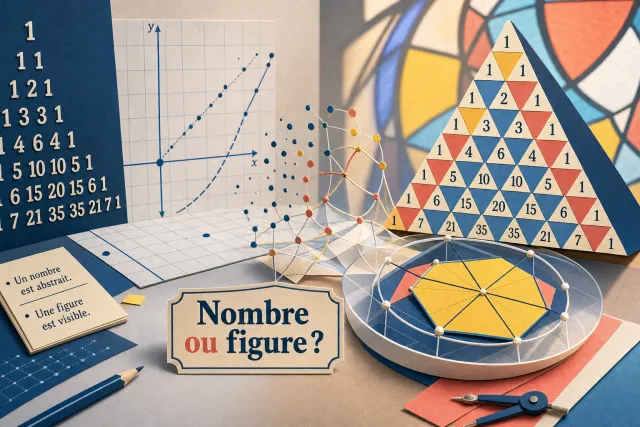
In Descartes's time, the practical use of mathematics was still very limited, a fact he lamented in the Discourse on the Method (part 1 ): "Thinking that they were of use only in the mechanical arts, I was astonished that, given the strength and solidity of their foundations, nothing more exalted had been built upon them." This astonishment reveals his intuition that mathematics would one day become the language of the physical sciences, as Galileo also proclaimed. But mathematics itself first required an advance, one pioneered by Descartes: using algebra to do geometry. By converting geometric objects into algebraic quantities, Descartes solved problems that had remained unsolved since antiquity, such as Pappus's problem (see box).
The mathematization of the world
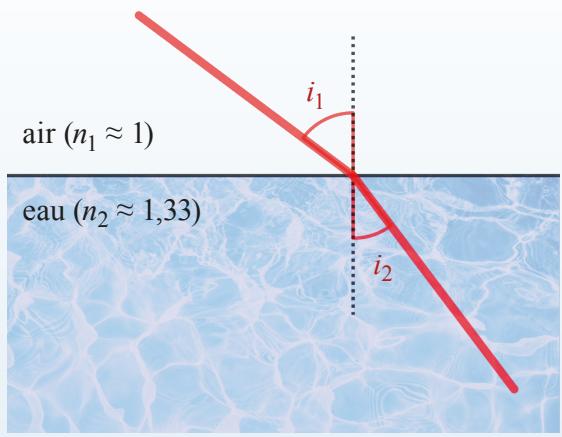
A second decisive advance for physics was the discovery of the mathematical laws of refraction. In Descartes's time, tables of the sine of an angle were already available. By comparing them with experimental results on refraction, Descartes discovered that for any two given media, such as air and glass, the ratio of the sine of the angle of incidence to the sine of the angle of refraction is constant. This is expressed by the relation , where and denote the angles formed with the interface between the media, while and are values specific to the media (the refractive indices).
Where the language of physics had dealt in concepts that remained vague, the advent of mathematics finally made a "clear and distinct" understanding of phenomena possible. Yet Descartes did not publish his results until 1637, alongside the Discourse on the Method, in which he began to set out his method of reasoning. He explored it more deeply in the Metaphysical Meditations of 1641. And, surprising though it may seem today, Descartes's path to certainty led through God.
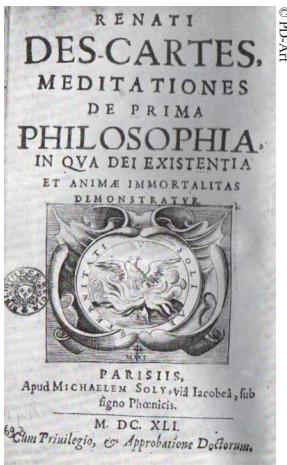
Descartes began with what he himself called hyperbolic doubt. What remains if I doubt everything—even the evidence of the senses (sight, hearing, and so on), the existence of my own body, and the things outside it? The philosopher expressed his "fear that [these inquiries], instead of one day bringing [him] some daylight and illumination in the knowledge of truth, might not be sufficient to dispel all the darkness surrounding the difficulties just raised." But after this anxious first Meditation, the second brought him to the certainty that if "something" thinks, then someone is thinking. And that someone is me. I think; and even if all the information I believe I receive through my external senses were false, the fact would remain that I think, that I exist, and that I can even define myself, at least as a thinking thing. In the third Meditation, Descartes adopted a new principle: all the ideas within him originate in a reality other than himself, even though his mind may subsequently process, combine, or distort them. Among all the substances of which he can form an idea, however, Descartes identified one that was infinite: God. Since he himself was not infinite, he could not be the author of this idea. From his initial principle, he then inferred that the idea of infinity, which could not come from him, came from a genuinely infinite substance. Hence the philosopher's conclusion: God exists.
From God to science
Descartes clearly distinguished his approach, which proceeded from meditation on his own thoughts, from religious faith, which requires revelation. In any event, Descartes was now certain of God's existence. What, then, became of science? In the fourth Meditation, he claimed to reveal "a path that will lead us from contemplation of the true God (in whom all the treasures of science and wisdom are contained) to knowledge of the things in the universe." Since God is perfect, he cannot deceive us or wish to deceive us.
Why, then, are we sometimes mistaken? Because our desire to be right—to think that we know—outruns our capacity genuinely to increase our knowledge. We often want to accept as true something that is plausible but not yet certain and ultimately proves false. To attain scientific certainty, we must therefore proceed with the utmost caution, accepting as true only what is certain, not what we wish to believe. Mathematics then provided Descartes with an analogy in his fifth Meditation:
"Nevertheless, when I consider the matter more attentively, I clearly find that existence can no more be separated from the essence of God than the fact that the sum of its three angles equals two right angles can be separated from the essence of a rectilinear triangle, or the idea of a valley from the idea of a mountain."
This is not a proof of God's existence. Rather, since God is perfect by definition and something that does not exist is necessarily less perfect than something that does, the very idea of God includes existence, just as the idea of a triangle includes the sum of its angles. Descartes was profoundly convinced by this argument, which may surprise us but from which he derived the firm foundation he had sought:
"And now that I know him [God], I have the means of acquiring perfect knowledge of infinitely many things, not only those that are in him, but also those belonging to corporeal nature, insofar as it can serve as the object of geometric proofs […]." Thus, knowing God, who does not deceive, Descartes could be certain that, provided he reasoned as geometers do, he was making true statements about external objects, insofar as those objects existed. Establishing this last point was the purpose of the final Meditation. Descartes began by observing that, among the thoughts that came to him, sensations (sight, hearing, pain, heat, and so on) imposed themselves upon him without his willing them. They did not therefore arise from his will. If the God who created him was not a deceiver, this meant that they impressed upon him something that necessarily came from outside. One problem remained, however: things were not necessarily as they appeared, because our senses sometimes perceived them "obscurely and confusedly." Descartes overcame the problem by assuming the soundness of mathematical concepts and the aid of God, who gives us the power to correct errors. God did not give us immediate and exact knowledge of the world, but rather the physical means of perceiving it through the senses and the intellectual means of attaining certain knowledge through orderly, mathematical reasoning. Descartes could then claim victory: the possibility of scientific knowledge of the world had been established.
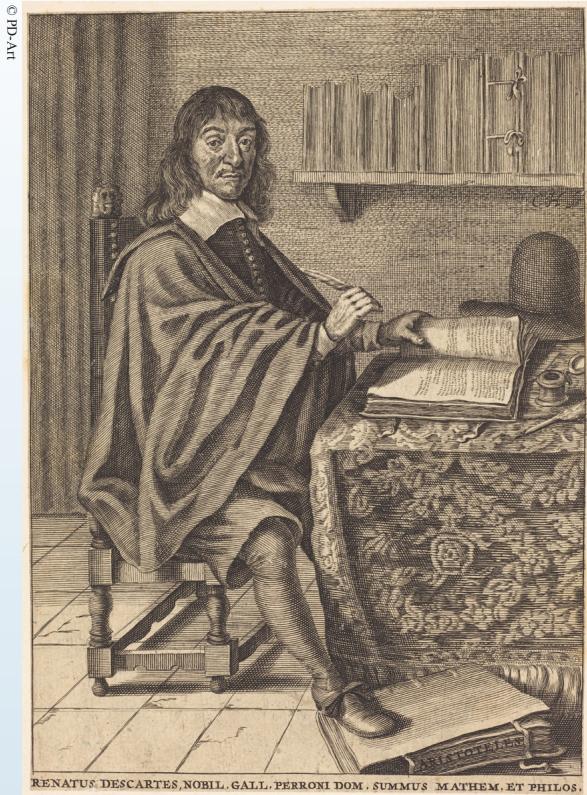
One final difficulty remained: why do our senses provide all this inaccurate information, forcing us to undertake such laborious mental work? Quite simply because their primary purpose is not to enable us to acquire scientific knowledge, but to ensure our basic survival. Thirst is meant to prompt us to drink when our body needs hydration; a burning sensation makes us pull our hand away from the fire before it is damaged; and so on. Descartes was nonetheless optimistic about our senses. In his view, although they give us only partial information about the world, cross-checking the evidence gathered in this way through orderly reflection allows us to find a path to truth:
"[B]eing able to use my memory to connect and join present knowledge with past knowledge, and my understanding, which has already discovered all the causes of my errors, I need no longer fear that there may be falsity in the things most commonly presented to me by my senses."
Cogito and intuition
A passionate physicist, Descartes had received an education no longer suited to the scientific advances of his time. He sensed that the rigor of mathematical reasoning could help us bring order to our ideas, and even that mathematical language should allow physical reality to be expressed adequately. Yet to distinguish properly between illusions, errors of reasoning, and the limitations of the senses—which give us only initial access to external reality—he needed both a foundation and a keystone. The foundation was his own existence, expressed in the famous "I think, therefore I am." The keystone was his intuition—an intuition rather than a proof—that a non-deceiving God exists. Without claiming that the philosophical picture he drew of God exhausted all that God is, it was enough to orient him and assure him that the scientific approach combining sensory experience, rigorous reasoning, and mathematical computation was the right one. In this sense, modern science is his heir.
References
- *Histoire de la science*, ed. Maurice Daumas, La Pléiade, 1957.
- *Les controverses sur le problème de Pappus dans la Correspondance de Descartes : 1637-1649*, Sébastien Maronne, 2008. Available online.