Philosophies rarely begin with banishment. Yet the Dutch philosopher Baruch Spinoza, of Portuguese Sephardic origin, was still very young when his community cast him out, its theologians rejecting him for the heresy of his thought. Later, in his Traité théologico-politique (1670), he called for a rational approach to the discourse of the Holy Scriptures, separated the realm of faith from that of reason, and urged peoples to free themselves from their fearful credulity in the face of kings and Churches.
Such wild audacity cannot be explained simply by the philosopher’s personality. To understand his thought, we must immerse ourselves in the atmosphere of a city, Amsterdam, and an era, the "Dutch Golden Age," when the United Provinces had freed themselves from Catholic Spanish rule. Spinoza was born in 1632, the same year as the painter Johannes Vermeer (1632–1675). The young nation, now Calvinist, established a new political model, a system of religious coexistence without a state Church, and a printing industry that spread new ideas. Spinoza and his friends turned away from transcendence to explore mathematics, medicine, and optics; they met at Leiden University to dissect brains and rethink everything from the ground up. This was the dawn of Baroque thought, when sceptical reason challenged every form of imposture.
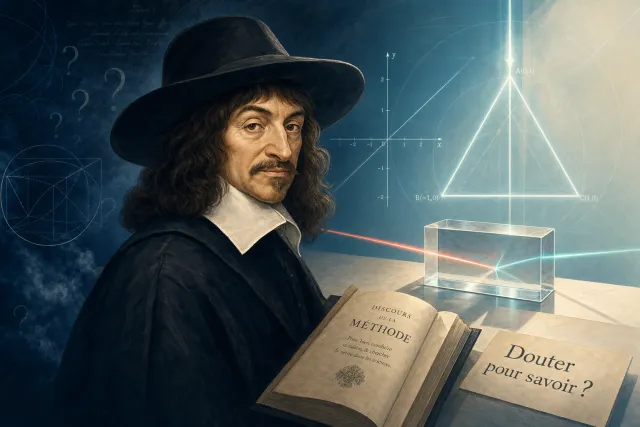
Spinoza was steeped in the writings of René Descartes (1596–1650) and in the ambition to understand nature through the language of mathematics. The rationality of the 17th century heralded the Enlightenment and reason’s instrumental power over reality. The idea of Nature gradually supplanted that of God.
Descartes’ influence
------------------------
"I have not seen Spinoza," said the writer Paul Valéry. The Dutch philosopher remains a genuine enigma. Even during his lifetime, the man was already disappearing behind his writings, while legend distorted the scant information available about his way of life (see box).
On the one hand, he was Judaeus and atheista ("Jew and atheist"): in other words, he combined the most abominable crimes imaginable at the time. He had to confront the religious authorities from an early age. When he proposed rereading Scripture, he was excommunicated by the synagogue on 27 July 1656 and accused of heresy and atheism. Forced into exile, he learned the craft of grinding lenses for spectacles and telescopes.