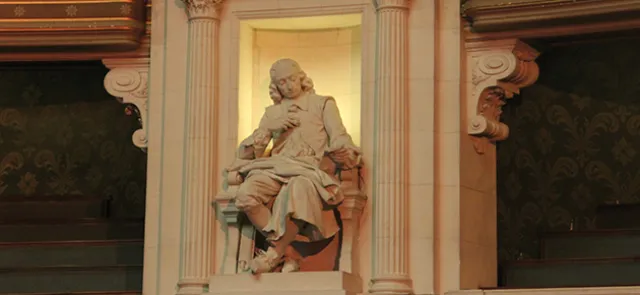
In her biography of her brother, Gilberte Périer describes the singular nature of Pascal's rhetoric: "He possessed a natural eloquence that gave him a marvelous facility for saying whatever he wished; but to this he had added rules that no one had yet conceived, and he used them to such advantage that he had complete command of his style. Thus, not only did he say whatever he wished, but he said it in precisely the manner he wished, and his discourse produced the effect he intended." The philosopher's thought drew on a multitude of influences and an exceptionally keen knowledge of classical rhetoric. His art of persuasion combined mathematical rigor with the flexibility of eloquence. His method varied according to the subject at hand.
Convincing or persuading
-----------------------
For Pascal, the art of persuasion is less noble than the art of convincing, since it addresses not reason but the listener's pleasure. Consequently, it is also more difficult, because tastes are as varied as people themselves, and persuasion means above all giving pleasure—touching in each person whatever will lead them to accept what is being proposed. According to Pascal, pleasure is "the currency for which we give whatever is asked of us". Yet identifying this "pleasure" is no easy matter, as L’Artdepersuader explains, since it varies not only from one person to another, but also within the same person.
We can therefore see why proof alone is insufficient when one must convince the "ordinary person." In the Pensées, Pascal writes that "geometers would be discerning if they had clear sight", while "discerning minds would be geometers if they could turn their gaze toward the unfamiliar principles of geometry." If persuasion is an art, Pascal calls for a kind of flexibility of the human mind: to think well, one must adopt the mathematician's standpoint, but one must also be able to grasp things as a whole and return to the world of sensory experience.
For Pascal, there are two ways of attaining truth. The first is "discursive reason," which proceeds step by step; the second is the "heart," which gives access to first principles such as infinity or the divine. But both kinds of certainty raise the question of how they can be communicated. The first, scientific certainty, can be communicated only to a small number of people. A lucid proof of an indisputable truth remains desperately opaque to most of humanity. The second certainty, that of faith, is so personal that it takes root in the most intimate and mysterious part of the human being.