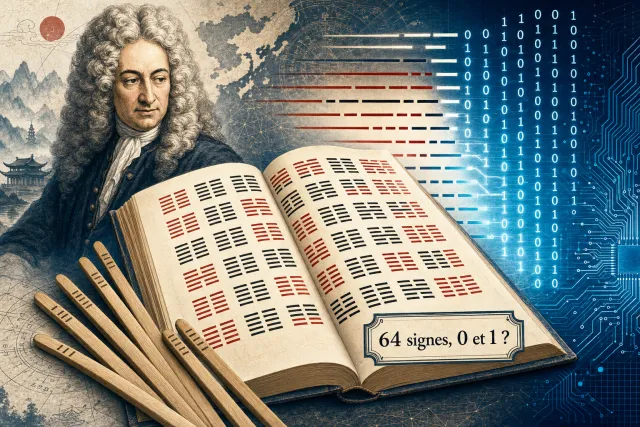
According to Leibniz, God's benevolence means that we live in "the best of all possible worlds". Behind this famous phrase, later mocked by Voltaire, lies the inventor of new methods of infinitesimal calculus that made it possible to calculate the maximum and minimum of a function.
Gottfried Wilhelm Leibniz (1646–1716) lived in the 17 century, a period when European science and mathematics certainly shone, but one also deeply steeped in religiosity. Yet the history of Christianity had always been marked by the old opposition between the theology of paradox and the theology of reason. According to the first, Christian belief lies beyond any scientific justification, and even surpasses everything we can reasonably think. The second, conversely, holds that Christians have a duty to be rational, since faith must be justified by solid arguments; mathematics and logic must therefore illuminate our understanding of divine creation. The rise of the new science in the 17 century reshuffled the deck in this old debate. Leibniz, at the forefront of both the mathematics and the philosophy of his time, was one of the leading figures of this transformation. According to the philosopher of Hanover, "it dishonors religion to strip it of proof and knowledge." For a believer, lacking light is worse than lacking warmth, hence the need to rationalize belief. This is why the program of Catholic demonstrations that Leibniz launched in 1668–1669, under the patronage of Baron von Boineburg, was devoted to demonstrating the existence of God, the sufficient reason and ultimate cause of all things.
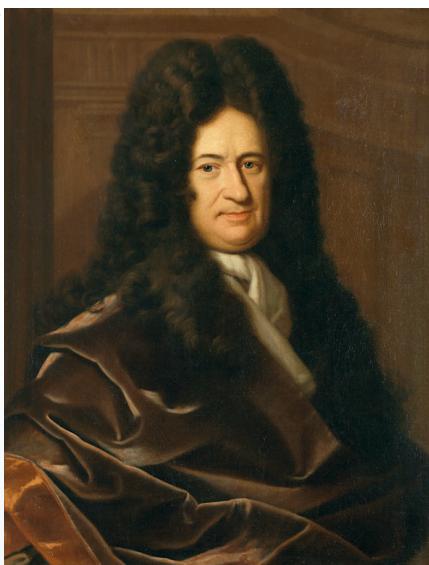
Can mathematics really satisfy this metaphysical ambition, which claims to account for the divine choice? If such a goal is permissible, then Leibniz is best placed to achieve it. He was the first to show that one can perform calculations on things other than numbers, and that there therefore also exists a mathematics of concepts and propositions. For him, mathematical logic does not merely serve to help us judge correctly; it is also the art of discovering unknown truths. This new combinatorial art should make it possible to determine, for any given reality, all the characteristics that define it. Everything is ultimately analyzable, including the contingent truths of existence.
Leibniz thus follows in the footsteps of Galileo, for whom the language of nature is that of mathematics, with its circles and triangles. Anyone who wants to understand a phenomenon must master this language.