



Feature: Does God exist? Mathematics facing proof
Can we prove God? Can we even reason about its existence? Between Pascal's wager, Leibniz's logical optimism, Whitehead's metaphysics and Laplace's famous refusal to add an unnecessary hypothesis, this feature explores the tense relationship between proof, belief and uncertainty. Mathematics does not necessarily provide an answer, but it shifts the question with rare power.
All articles in this folder
 Podcast
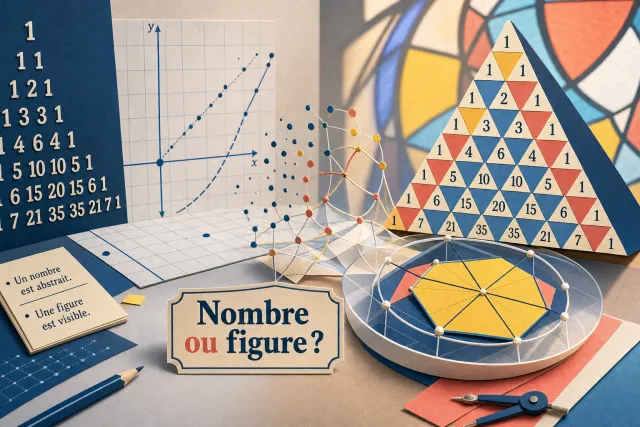
Geometry as incarnation: Pascal and the primacy of figures
How Blaise Pascal favored figures over numbers, even solving combinatorial problems through the geometry of the arithmetic triangle.
 Podcast
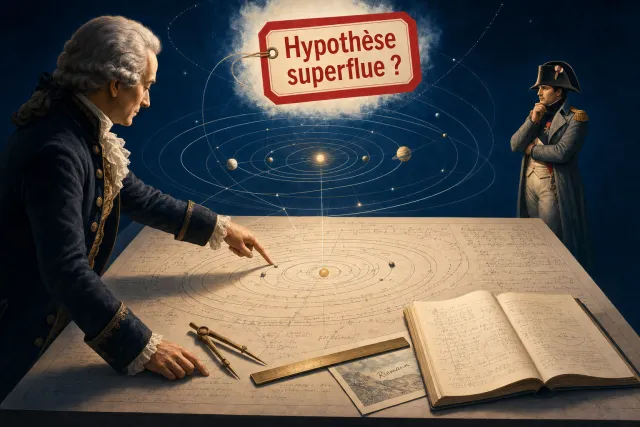
Mathematicians and atheism: Laplace, Erdős and Hardy defy God
Laplace, Erdős and Hardy: three anecdotes about mathematicians who used logic and mathematics to question the existence of God.
 Podcast
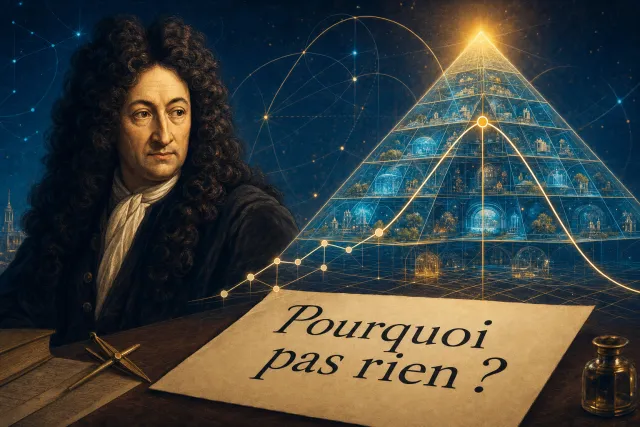
Leibniz and the best of all possible worlds: mathematics and philosophy
How Leibniz uses mathematics to justify the existence of the best of all possible worlds through infinitesimal calculus, symmetry, and philosophy.
 Podcast
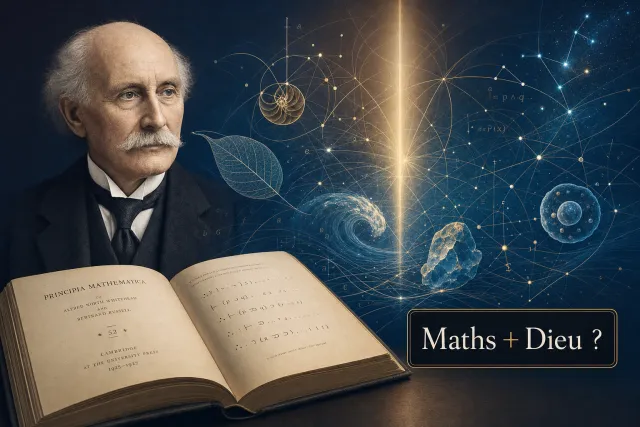
Whitehead: logical harmony of mathematics and philosophy
A journey into the thought of Alfred North Whitehead, who laid the foundations of the Principia Mathematica with Russell and developed a metaphysics of the cosmos in which God and mathematics work together in the world's unfolding.
 Podcast
Pascal's Wager: probability and faith in mathematical analysis
An explanation of Blaise Pascal's famous argument about the wager of faith, applying probability theory to the question of God's existence.