Rather than asking whether God exists, why not accept uncertainty and reason with probabilities instead? A Christian thinker as much as the founder of the "geometry of chance," Pascal was just the man to frame the question of faith as a wager.
A philosopher and mathematician, Blaise Pascal was also a devout believer, whose famous Pensées were originally to be titled Apologie de la religion chrétienne (see also the article "La géométrie comme incarnation"). It is in this work, first published posthumously in 1670, that we find an original argument meant to convince readers of the value of believing in God. This is Pascal's Wager, a radically new approach to an age-old question.
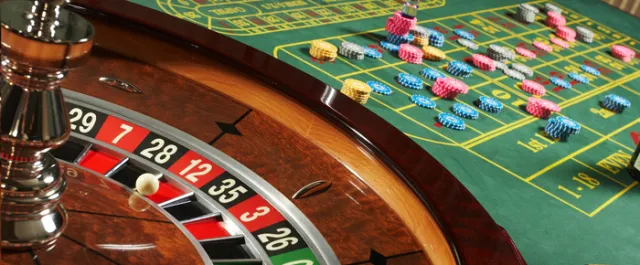
Addressing someone who doubts, Pascal does not try to prove that God exists. More modestly, his aim is to show that believing is also a matter of self-interest properly understood — in the sense of a casino gambler who, though uncertain of the outcome of a random toss, wonders what to bet on to maximize his chances of winning.
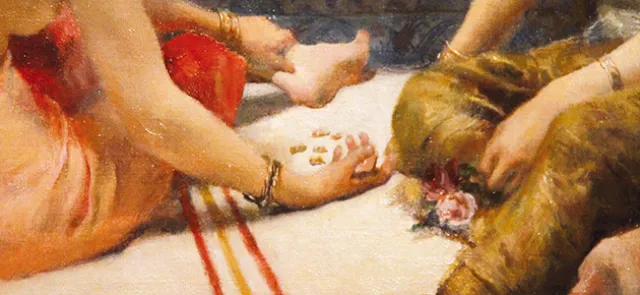
In Pascal's time, probability theory was still in its infancy. The only significant work published on the subject was Gerolamo Cardano's Livre du jeu de hasard (Book on Games of Chance), written a century earlier (around 1564). Along with Fermat, Pascal was the one who truly launched mathematical research on the question. Yet far from the gambling houses frequented by the libertine Cardano, Pascal thus brought probability into theology.
To show that it is in our interest to choose to believe in God, Pascal begins by presenting the situation as a coin toss. To put it here in modern terms, the probability of winning is 1/2, and we assume that the stake required to play is €1. The player's payoff when the coin lands on the winning side must then logically be €2. Without saying so, to find this value Pascal implicitly performs an expected value calculation — that is, the sum of the possible payoffs of the game, weighted by the probability of each outcome. In our coin toss, at the end of the game the player who lost ends up with €0 and the one who won with €2. Since the probabilities of winning and losing are both equal to 1/2, the expected value is obtained by the very simple calculation